
The difference between German, American and British hose clamp
It is well known that the German, American, and British hose clamps are the three most widely used and best-selling classic types on the market. Next, we will introduce their specific differences in detail to help you better procure hose clamps that match your application scenarios.
German Style Hose Clamp
The German-style hose clamp typically uses a non-perforated steel band with a convex outer groove and concave inner groove. This design provides even clamping force, avoiding cutting force on the hose during tightening, which effectively protects your expensive silicone or high-pressure rubber hoses from damage. Additionally, the German-style steel band is formed with a special toothed structure through stamping during production, which tightly engages with the screw, thus ensuring strong locking and leak-proof capabilities. Installation is also less likely to slip.
German-style hose clamps are primarily manufactured according to the DIN 3017 standard. The common material types include W1, W2, W4, and W5 (the specific material differences can be found in the FAQ section of this article). The most common German-style clamps in the market are W2 semi-stainless steel and W4 full stainless steel. The former offers good torque and moderate pricing, making it ideal for industrial connections, while the latter has strong corrosion resistance, making it suitable for automotive and outdoor applications. These two types of German-style clamps have a high market share, and our sales volume is also good. If you want to simplify your inventory, prioritizing these two material choices would be more efficient.

American Style Hose Clamp
American-style hose clamps typically use a perforated steel band structure (either rectangular holes or willow holes), allowing the screw to directly engage with the steel band, making installation straightforward and easy to adjust. At the same time, the perforated design offers a broader range of adjustable sizes. While covering the mainstream pipe diameters on the market, the number of size SKUs for American-style clamps is fewer than that of German-style clamps, which helps reduce the complexity of inventory specifications.
The material types of American-style hose clamps are compatible with the DIN 3017 standard, with common types including W1, W2, W4, and W5, or combinations of SS201, SS304, SS316, and galvanized carbon steel. For example, the popular W2B version in the market uses a combination of stainless steel 201 steel band, galvanized steel clamp head, and galvanized steel screw. This version is much cheaper than the full stainless steel 304 version, yet provides adequate tightening capability, making it a favorite among many hose connection customers. If you want to stock popular high-volume items, choosing the W2B American-style hose clamp is definitely a good choice.

British Style Hose Clamp
The steel belt of British-style hose clamps typically features a non-perforated concave groove on the outer side, while the inner side is very smooth and flat. This overall design offers excellent leak-proofing and tightening capabilities. Compared to the German and American styles, the steel belt of British-style clamps is thicker, reaching 0.8-1mm. Additionally, the worm gear base usually adopts heavy-duty structures such as spot welding, riveting, and hook heads. Therefore, whether dealing with over-tightening by power tools or high-vibration environments like heavy truck engines, British-style hose clamps maintain strong compressive and long-term tightening performance. This is extremely helpful for reducing maintenance frequency and after-sales risks.
British-style hose clamps comply with the UK BS5315 standard. If you plan to sell in Commonwealth countries or the shipbuilding industry, choosing British-style hose clamps can support higher retail prices.

Comparison Table of German, American, and British Hose Clamps
| Parameter | German type hose clamp | American type hose clamp | British type hose clamp |
| Structure Features | Non-perforated steel band (stamped) | Perforated steel band (rectangular or willow holes) | Non-perforated steel band (stamped) |
| Common Materials | W1 (Galvanized steel) / W2 (Stainless steel + galvanized screws) / W4 (Full stainless steel) / W5 (Full stainless steel) | SS201 / SS304 / SS316 / Galvanized carbon steel | galvanized carbon steel / Full stainless steel (304/316) |
| Width | 9mm / 12mm | 8mm / 12.7mm | 9.7mm / 11.7mm / 12.7mm |
| Thickness | 0.6mm - 0.7mm | 0.5mm - 0.6mm | 0.8mm - 1.0mm |
| Size Range | 8mm - 160mm+ (Common range: 16-27, 20-32, 32-50, etc.) | 6mm - 300mm+ (Wide range, supports large diameter adjustment) | 12mm - 200mm+ |
| Application | Precise, standardized, commonly used for automotive OEM and industrial connections | Flexible and cost-effective, suitable for HVAC, agricultural irrigation, automotive aftermarket, etc. | Heavy-duty, suitable for heavy industries and offshore engineering connections |
Extended Customization of Hose Clamps
Standard hose clamps encounter different pain points in actual use, and over time, some common issues have led to the development of targeted custom hose clamps. Below are the common types:
Quick Release, Offset, and Cover-Type Worm Gear Base
If your project requires frequent disassembly of pipe fittings, the quick-release feature is essential. For some large ventilation ducts, the threading process can take minutes. However, with the quick-release version, this time can be shortened to just a few seconds, significantly reducing labor costs and downtime for maintenance.
Common quick-release versions include flip-hinge style and handle style. The flip-hinge version is more common in American quick-release clamps. There are many variations on the market, but they all operate on a similar principle. The screw seat has a pivot on one side, which allows it to be slightly loosened and then flipped open, causing the steel band to pop out. The handle style features a handle on the screw head, often made of stainless steel or plastic, which allows manual adjustment of the clamp. While it doesn't instantly release the steel band, it's ideal for situations requiring frequent manual hose adjustments. Quick-release models are mostly found in American and German-style hose clamps. As for British-style clamps, the design focuses on long-term tightness, so quick-release features are obviously counterproductive.

Additionally, when tightening conventional hose clamps, the worm gear generates an upward force, which can cause the clamp to “lift” and reduce localized clamping force. The offset structure moves the base to one side, making the connection between the base and the steel band asymmetric. This offsets the upward force generated by high torque and ensures uniform, circumferential, tight sealing. This feature helps meet the needs of high-performance OEM manufacturers.

The cover-type base adds a protective cap under the base to prevent the hollow steel band of the American-style clamp from directly contacting the hose and causing cutting damage. Therefore, the cover-type base is primarily used in American-style hose clamps.
Bridge, Compensation, and Positioning Hole Steel Band Structures
If the surface of the hose you need to clamp is uneven, conventional hose clamps will inevitably create gaps. The bridge structure helps address this by welding an arched metal piece to the base or steel band of the clamp, ensuring a perfect fit with the hose and achieving a true circumferential seal. We can also customize double-bridge or other variations of the bridge structure based on your specific requirements.

In some exhaust systems or other pipe connections subject to thermal expansion and contraction, rigid clamps can't compensate for this strain, making long-term sealing impossible. The compensation structure solves this problem by embedding a wavy stainless steel sheet inside the steel band, allowing the clamp to adjust autonomously. These structures are typically found in German-style hose clamps.
On high-volume, fast-paced assembly lines, hose clamps need to be manually aligned and adjusted. If you want to improve throughput and ensure installation consistency, adding positioning holes is crucial. The steel band positioning holes serve as physical reference points for gripping and alignment, making the clamp more suitable for automatic assembly in factories.

Constant Torque Worm Gear Hose Clamps
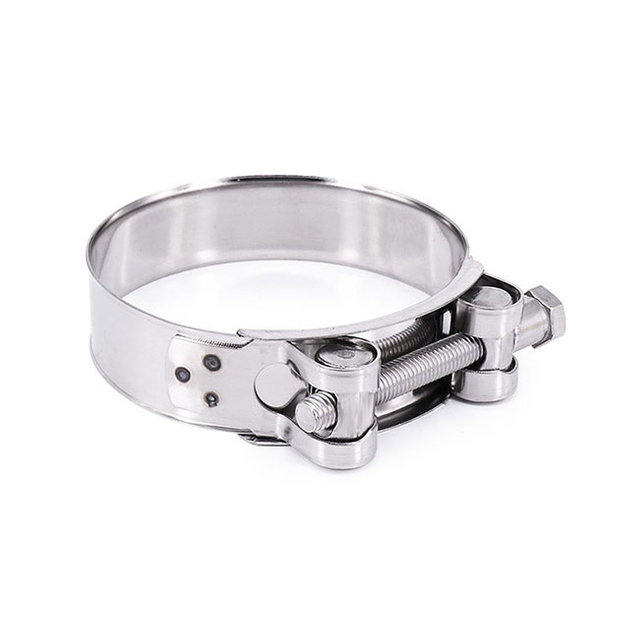
Similar to the steel band compensation mentioned earlier, these high-load, heavy-duty spring hose clamps are designed to compensate for the thermal expansion and contraction stresses of pipe fittings. However, the compensation force from stacked disc springs is significantly greater than that of the previous structure. Since the pressure comes from the screw end, there may be slight attenuation over long distances, which could lead to less uniform pressure than the previous design. Therefore, these clamps are better suited for heavy-duty equipment and large exhaust pipes.
If you require a wider adjustment range and stronger compensation capabilities, you might want to consider American-style heavy-duty hose clamps. Compared to the common heavy-duty T-bolt clamps, their cost is lower, yet their compensation effect is nearly the same.

Common FAQ
Q: What are the material differences between W1-W5 hose clamp combinations?
A: The differences are as follows:
| Code | Material Combination | Corrosion Resistance | Features |
| W1 | Full carbon steel (galvanized steel for band, screw, and base) | Low | Cost-effective, suitable for indoor, dry environments. |
| W2 | Semi-stainless steel (stainless steel band/base 430/200/304, galvanized carbon steel screws) | Medium | Industrial standard, good torque performance at moderate cost. |
| W3 | Full 430 stainless steel | Medium-high | Magnetic stainless steel, less common. |
| W4 | Full 304 stainless steel | High | Non-magnetic, highly corrosion-resistant, suitable for automotive and outdoor use. |
| W5 | Full 316 stainless steel | Extremely high | Specially designed for marine, chemical, and highly corrosive environments. |
Conclusion
In general, American-style hose clamps are more versatile, affordable, and widely sold in retail markets, while German-style clamps are more standardized, and British-style clamps focus on strength. We are a professional hose clamp manufacturing factory, equipped with dozens of fully automated hose clamp production machines that combine assembly, stamping, and welding. Our production capacity reaches 1.2 to 1.5 million clamps per day. We maintain a stock of common sizes and materials, offer global prompt delivery, and support detailed customizations and packaging. Feel free to contact us for cooperation.


About Yueding
YUEDING manufactures stainless steel exhaust flexible connectors, clamps, metal bellows, and selected automotive exhaust components under ISO and IATF quality systems. With in-house production, inspection, and packaging capabilities, we support bulk orders, standard-size inventory, and customized branding for global B2B customers.
Reliable Delivery
Stable production planning, standard-size inventory, and batch shipping support help make delivery more predictable.

Factory Direct
Production, inspection, and packaging are managed in-house, making communication, quality control, and customization more efficient.

Integrated Supply
We supply flex pipes, clamps, metal bellows, and selected exhaust components to support related purchasing needs from one manufacturer.

