|


Mn Steel Spring Band Hose Clamps
65Mn steel constant tension spring band hose clamps maintain steady pressure as hoses expand and contract under temperature changes and vibration. Standard sizes cover Ø7–25 mm, with multiple band widths, thicknesses, and surface finishes available. We supports OEM sizes, custom packing, and laser marking for automotive cooling, fuel line, and industrial hose assemblies.
Product Description
Our 65Mn steel constant tension spring band hose clamps maintain steady pressure as hoses expand and contract under temperature changes and vibration. Standard sizes cover Ø7–25 mm, with multiple band widths, thicknesses, and surface finishes available. We support OEM sizes, custom packing, and laser marking for automotive cooling, fuel line, and industrial hose assemblies.
How Spring Band Hose Clamps Work
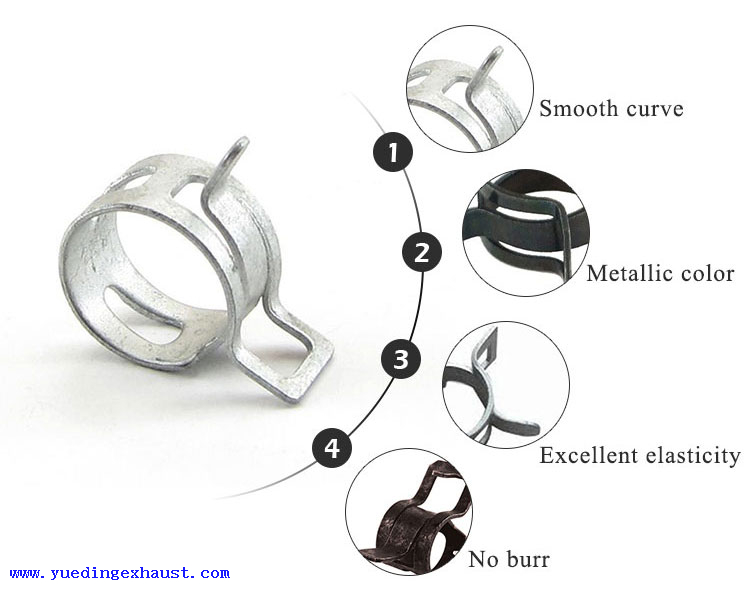
Spring band hose clamps use the elastic recovery force of spring steel to hold a hose securely against a fitting. Unlike a screw-type hose clamp, the clamping force does not depend on a manually applied tightening torque.
When the hose expands as temperature rises, the spring band expands with it. As the hose contracts during cooling, the clamp follows the change and continues applying pressure around the connection.
This self-compensating action makes a spring band clamp particularly useful where repeated heating, cooling, vibration, or hose movement may affect the joint.
There is no screw mechanism that needs periodic tightening. Once the correct clamp size is selected and properly installed, the spring action continuously reacts to small dimensional changes in the hose connection.
Our spring band hose clamps are commonly supplied for automotive cooling systems, fuel lines, rubber and plastic hose connections, and industrial hose assemblies.
65Mn Spring Steel Construction
We use 65Mn spring steel as the standard material for these spring band hose clamps. 65Mn combines the hardness and elastic recovery required for a clamp that must repeatedly open during installation and return toward its original diameter afterward.
Heat treatment is an important part of production. We control the process to maintain a practical balance between elasticity and hardness. The clamp must retain spring force without becoming excessively soft or unnecessarily brittle.
This is particularly important in applications exposed to repeated temperature cycles or vibration, where consistent spring behavior matters more than simply producing a high initial clamping force.
Band edges and forming accuracy are also controlled during production so that the clamp can sit evenly around the hose without depending on a screw housing or separate tightening component.
Spring Band Hose Clamp Specifications
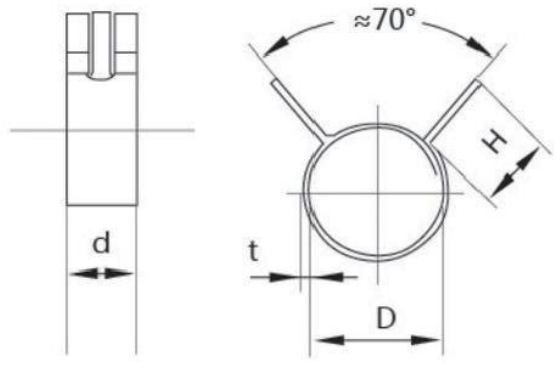
Our standard spring band hose clamp range covers natural inner diameters from Ø7 mm to Ø25 mm. Depending on clamp diameter, available band thickness ranges from 0.6 mm to 1.5 mm, while band width ranges from 6 mm to 15 mm.
| Natural ID - D (mm) | Expanded ID - D1 (mm) | Installation Space - D2 (mm) | Thickness - S/T (mm) | Band Width - B/d (mm) |
|---|---|---|---|---|
| φ7 | 7.6 | 8.3 | 0.6 | 6.0 |
| φ8 | 8.6 | 9.5 | 0.6 / 0.8 | 6.0 / 8.0 |
| φ8.5 | 9.2 | 10.2 | 0.6 / 0.8 | 6.0 / 8.0 |
| φ9 | 9.7 | 10.7 | 0.6 / 0.8 | 8.0 |
| φ9.5 | 10.3 | 11.3 | 0.8 | 8.0 |
| φ10 | 10.8 | 11.9 | 0.8 | 8.0 |
| φ10.5 | 11.4 | 12.5 | 0.8 | 8.0 |
| φ11 | 11.9 | 13.1 | 0.8 | 8.0 |
| φ11.5 | 12.4 | 13.7 | 0.8 | 8.0 |
| φ12 | 13.0 | 14.3 | 0.8 | 8.0 |
| φ12.5 | 13.5 | 14.9 | 0.8 | 8.0 |
| φ13 | 14.0 | 15.5 | 0.8 | 8.0 / 10.0 |
| φ13.5 | 14.5 | 16.1 | 0.8 | 10.0 |
| φ14 | 15.1 | 16.7 | 0.8 | 10.0 |
| φ14.5 | 15.7 | 17.3 | 0.8 | 10.0 |
| φ15 | 16.2 | 17.0 | 1.0 | 10.0 |
| φ15.5 | 16.7 | 18.4 | 1.0 | 10.0 |
| φ16 | 17.3 | 19.1 | 1.0 | 10.0 |
| φ16.5 | 17.9 | 19.7 | 1.0 | 10.0 |
| φ17 | 18.4 | 20.2 | 1.0 | 10.0 |
| φ17.5 | 18.9 | 20.9 | 1.0 | 10.0 |
| φ18 | 19.4 | 21.4 | 1.0 | 10.0 |
| φ18.5 | 20.0 | 22.1 | 1.0 | 10.0 |
| φ19 | 20.5 | 22.6 | 1.0 | 10.0 |
| φ19.5 | 21.1 | 23.3 | 1.0 | 10.0 |
| φ20 | 21.6 | 23.8 | 1.0 / 1.2 / 1.5 | 12.0 / 15.0 |
| φ20.5 | 22.2 | 24.4 | 1.0 | 12.0 |
| φ21 | 22.7 | 25.0 | 1.0 / 1.5 | 12.0 / 15.0 |
| φ23 | 24.8 | 27.4 | 1.2 / 1.5 | 12.0 / 15.0 |
| φ24 | 25.9 | 28.5 | 1.2 / 1.5 | 12.0 / 15.0 |
| φ25 | 27.0 | 29.8 | 1.2 / 1.5 | 12.0 / 15.0 |
Technical Notes for Clamp Selection
Natural ID (D): The nominal clamp size refers to its natural inner diameter before installation. Spring band hose clamps are fixed-size spring components rather than screw-adjustable clamps.
The selected natural diameter should therefore be slightly smaller than the outside diameter of the assembled hose and fitting so that sufficient spring force remains after installation.
Expanded ID (D1): This value shows the clamp diameter after the ears have been compressed for installation. It helps determine whether the clamp can pass over the hose and fitting during assembly.
Installation Space (D2): Check this value when the hose connection is located in a restricted area. D2 indicates the space required around the clamp while its ears are opened.
Size Tolerance: A nominal size does not always equal the exact measured inner diameter. For example, a nominal 12.5 mm clamp is normally controlled within approximately 12.3–12.45 mm.
Selecting a spring clamp only from the hose's nominal inside diameter can lead to an incorrect fit. For production projects, use the outside diameter of the hose after it is installed on the fitting as the main dimensional reference.
Wholesale Customization
Surface Treatment Options
Different operating environments require different levels of corrosion protection and surface appearance.
We offer several surface treatments for 65Mn spring band hose clamps, allowing the coating to be selected according to environment, corrosion requirements, appearance, and project cost.
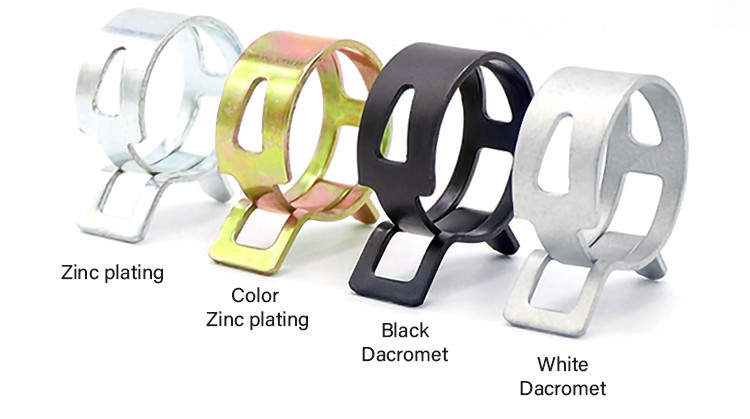
| Surface Treatment | Characteristics | Cost Level |
|---|---|---|
| Color Zinc | Strong rust resistance; surface does not oxidize easily; color remains stable. | Low |
| White Zinc / Blue-White Zinc | High coating uniformity and widely used for general-purpose applications. Environmental compliance can be confirmed according to the specified plating process. | Low |
| Nickel Plating | Fine surface finish with a smooth, bright appearance; also improves wear resistance and reduces surface friction. | Higher |
| Dacromet | Designed for higher corrosion resistance. Specified coating systems can achieve salt-spray performance of up to 1000 hours when required by the project. | Higher |
| Electrophoresis | Produces a uniform coating with limited dripping or edge buildup and provides a consistent decorative finish. | Higher |
For general automotive and industrial assemblies, zinc-based coatings are commonly selected where cost and corrosion protection must be balanced.
For projects exposed to more demanding corrosion conditions, Dacromet or another specified coating can be evaluated according to the required salt-spray target.
Because corrosion performance depends on coating thickness, pretreatment, test standard, and actual environment, please provide your required corrosion specification when requesting a quotation.
Typical Applications
Automotive Cooling Systems
Spring band hose clamps are widely suited to radiator hoses, coolant lines, heater hoses, and related connections where rubber hoses repeatedly expand and contract during engine heating and cooling. Their spring action allows the clamp to follow these dimensional changes without relying on a fixed screw setting.
Fuel and Fluid Lines
Compact spring clamps can be used on suitable fuel, fluid, and low-pressure hose assemblies when the clamp size, hose material, fitting design, and operating conditions are properly matched. For critical fluid systems, the complete connection should be validated rather than selecting a clamp from diameter alone.
Industrial Hose Assemblies
Industrial equipment often contains short rubber or plastic hose connections exposed to vibration and repeated operating cycles. Spring band clamps provide a compact fastening method for these connections and are particularly useful where access for repeated screw tightening is inconvenient.
Machinery and Equipment
The simple one-piece construction is suitable for equipment manufacturers that need fast, repeatable hose assembly.
Available diameter, width, thickness, and coating options also make the clamp easier to match to different hose constructions and equipment environments.
Vibration-Sensitive Connections
A rigidly adjusted clamp may not react to every dimensional change in a flexible hose. A correctly selected spring band clamp continues applying spring force as the connection moves within its intended operating condition, making it useful for assemblies exposed to normal machinery or vehicle vibration.
Installation and Size Selection
Correct clamp selection starts with the assembled hose connection. Measure the outside diameter of the hose after it has been fully seated on the pipe, barb, or fitting. Do not select a clamp only according to the hose's nominal inside diameter.
Next, compare the assembled hose diameter with the clamp's Natural ID (D) and Expanded ID (D1).
The natural diameter should provide sufficient interference to create spring force, while the expanded diameter must provide enough clearance for installation.
In restricted engine compartments or machinery assemblies, also check the D2 installation-space dimension before finalizing the clamp.
For installation, compress the two clamp ears with suitable spring clamp pliers. Slide the opened clamp over the hose, position it correctly over the connection area, and release the tool gradually.
The clamp should sit squarely around the hose rather than at an angle. With suitable tools and an established repetitive assembly process, installation can typically be completed in about two seconds. Actual assembly time will vary with clamp size, operator experience, tooling, and access around the hose.
Before approving a production order, we recommend checking the selected clamp on the actual hose and fitting combination.
OEM and Wholesale Customization
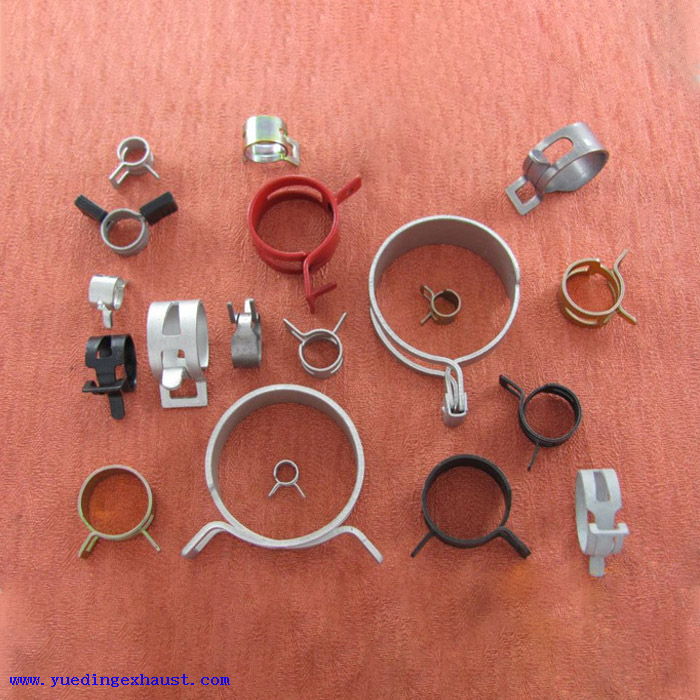
We manufacture spring band hose clamps for standard supply and OEM projects. Standard material is 65Mn spring steel, while diameter, band width, material thickness, and surface treatment can be reviewed according to your application.
Available surface options include Dacromet, color zinc, white zinc, blue-white zinc, electrophoresis, and nickel plating.
We can also support custom packaging and laser marking when required.
Our standard minimum order quantity is 100 pcs. For non-standard projects, we can review your drawing, sample, hose outside diameter, fitting dimensions, required band width, material thickness, coating, packaging method, and order quantity before production.
We provide basic design support for custom spring clamps. Our in-house forming and heat-treatment control also helps us maintain more consistent spring characteristics between production batches. For customers using several specifications, send us your required size list so we can review the most practical supply arrangement.
FAQ
Can 65Mn spring band clamps be used with silicone hoses?
They can be used with suitable silicone hose assemblies, but the clamp must be matched to the actual hose wall thickness, assembled outside diameter, and fitting design. A sample assembly test is recommended before volume production.
Are spring band clamps suitable for every pressurized hose connection?
No single hose clamp type is suitable for every pressure condition. System pressure capability depends on the hose, fitting geometry, clamp dimensions, installation, temperature, and operating medium. Provide your working conditions so the complete connection can be evaluated.
Can a spring band hose clamp be removed and installed again?
A clamp can often be opened again with suitable pliers. Before reuse, inspect it for permanent deformation, corrosion, cracks, coating damage, or loss of spring action. Replace the clamp if its condition is uncertain.
What information should I provide for a custom spring clamp?
Useful information includes the assembled hose outside diameter, hose and fitting material, fitting dimensions, required clamp diameter, band width, thickness, coating, application environment, packaging requirement, and expected order quantity. A sample or technical drawing can also help with matching.
How should unused 65Mn spring clamps be stored?
Keep the clamps dry and protected from chemicals, condensation, and conditions that may damage the surface coating. Avoid deforming or unnecessarily expanding the clamps during storage and transportation.