
How To Choose An Exhaust Band Clamp for Your Pipe Joint
The pipe is marked 3 inches, and you’ve found three clamps with the same size on the label. Which one fits? Look at the joint first. A butt joint brings two pipe ends together. A lap joint has an outer pipe or socket that slides over an inner pipe. The surfaces under the band differ, even when both jobs use tubing sold as 3-inch.
To choose an exhaust band clamp, identify the joint, measure the pipe where the band will sit, and check how much room the clamp and its hardware need. Those checks also tell you what to ask when a listing gives you a single nominal size.
Start With the Joint You Need to Clamp
Look at how the two pieces meet. If the pipe ends meet face to face and have matching outside diameters, start with a butt joint design. If one pipe slides inside the other, follow the change in outside diameter where the outer pipe ends. Use that profile to check the clamp designed for the overlap.
What you see at the joint | Which clamp to compare | What to check |
|---|---|---|
Two same-diameter pipe ends meet at a seam. | Butt joint band clamp. | Both outside diameters and the straight pipe available on each side. |
An outer socket overlaps an inner pipe, leaving a step. | Stepped lap joint band clamp. | Both clamping diameters and where the band step will land. |
The overlap has a defined seat for a narrow sealing band. | An O-type seal clamp specified for that joint. | The OD at the seat, the usable width, and compatibility with the overlap profile. |
If the connection has two flanges, identify the flange and closure first. An exhaust pipe band clamp sized around plain tubing is designed for a different connection. A new clamp also needs sound metal to bear on. If the existing pipe is split, heavily corroded, or visibly out of round at the seat, have the pipe condition assessed before you choose hardware.
Measure Where the Band Will Sit
Take measurements on the surfaces the band actually contacts. For a butt joint, take an outside diameter (OD) reading on each pipe beside the seam. For a stepped overlap, record the OD on the outer socket and the OD on the exposed inner pipe beside it. Mark which reading came from which side. A measurement at a bend, flared lip, or weld bead may describe a different surface from the one the clamp will grip.
Next, measure the usable straight length. On a butt joint, take a separate reading on each side of the seam. If a bend or weld starts close to the seam, the band may run onto it before the other side has enough contact. On a lap joint, record the overlap length separately from the straight length available for the band. Overlap is how far the pipes engage. Band width is how much space the clamp occupies. If the inner pipe is hidden, use the assembly drawing or a verified insertion mark to establish the overlap.
Check the space around the bolts, too. A clamp can fit around the tube and still put its closure against a heat shield, rail, or bracket. A side photo showing the joint and surrounding space gives the parts supplier more to work with than a close-up of the old clamp. If an expanded socket is being checked before assembly, its inside diameter (ID) can help confirm that the tubes mate. The band is selected using the outside surfaces it will contact once they are together.
Mark your measurements A and B. On a butt joint, mark the pipe on each side of the seam. On a lap joint, mark the inner-pipe OD and the outer-socket OD. Use the same labels on the photo and in your parts request.
3-Inch Exhaust Band Clamp Example: Butt Joint vs. Lap Joint
These two examples use published Yueding sizes to show how the selection changes with the joint. Use your own pipe measurements for the final fit check.
Example A: Two 3-inch pipe ends meet at a seam
Suppose the two pipe ends both measure 76.2 mm OD at the clamp seat and line up end to end. The 3-inch butt joint exhaust clamp is listed for a 76.2 mm pipe OD. It has a standard band width of 76 mm. Compare that footprint with the straight pipe available on both sides and check the model’s required band position. For instance, if a welded bracket leaves just 30 mm of straight pipe on one side, a 76 mm band centered on the seam would occupy 38 mm on that side and run into the bracket. The pipe diameter matches the catalog entry, while the space for that band position falls 8 mm short. Check the product drawing before choosing another width or position.
A stepped lap clamp would put two different band profiles across this joint, where both outside surfaces are the same size. For this example, keep the butt style as the candidate and resolve any clearance issue using the dimensions of the actual part.
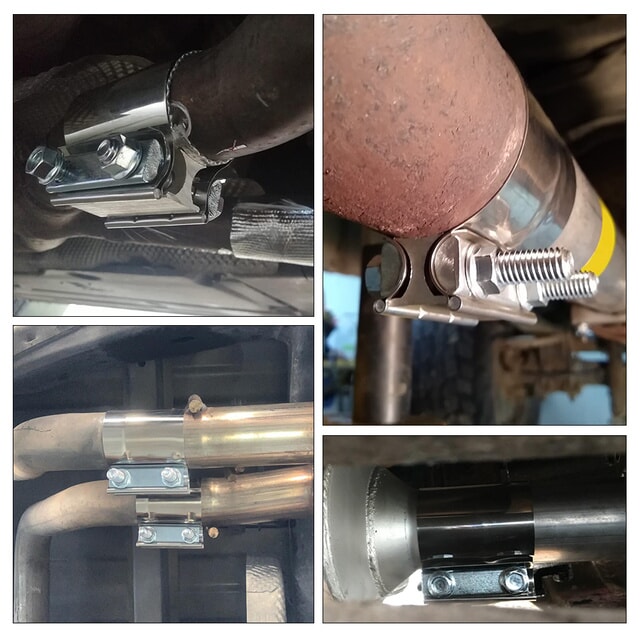
Example B: A 3-inch pipe slips into an expanded socket
Now take a 3-inch replacement tube that slides into an expanded muffler inlet. The visible end of the inlet forms a step down to the inner tube. Yueding offers a nominal 3-inch lap joint exhaust clamp with two sides to match this type of connection. Give the supplier the OD on each side of the step and the available seat length. Ask which of the clamp’s two dimensions corresponds to each surface on your joint. The 3-inch label identifies the size entry. The fit depends on where the step falls and how the two sides seat against the actual pipes.
A straight butt band can touch the larger socket before it seats properly on the smaller pipe. An O-type seal clamp is another option where the overlap and seat match the specific product design. For example, Yueding’s O-type seal clamp pairs its 3-inch entry with a 76 mm pipe OD and has a standard band width of about 32 mm. Check the applicable joint profile and the OD at the intended seat before choosing it for the overlap.

What to Check Before You Order a Band Clamp
Use the size in the listing to find a candidate, then check the product profile against your joint. If the specifications give a single pipe size, confirm where it applies. If they give two diameters, ask which clamp surface each one describes. Published band dimensions and the actual pipe diameters answer different questions, so keep the drawing and your measurements together.
Joint type. Record end-to-end or overlapping and attach a side view.
Two outside diameters. Label which measurement belongs to each side.
Band space. Include usable straight length and the distance to any weld or bend that limits where the band can sit.
Overlap and step. Mark both on a slip-fit joint and note any slots in the outer socket.
Tool access. Check the space for the closure and the tool you will need to reach it.
For repeat buying, save the approved part reference or drawing with the joint measurements. That lets a colleague reorder the same exhaust band clamp even if another item in the catalog has the same nominal diameter. If a shop is replacing the muffler or flex pipe at the same time, check the new component’s end geometry before reordering the old clamp.
Start with the pipe joint and buy the clamp that fits it. On equal-OD pipe ends that meet at a seam, verify the butt band’s contact on both sides. On a slip fit, confirm where the clamp steps down or where a narrow sealing band will sit. Before ordering from Yueding or matching a replacement in stock, keep a side photo with both measured ODs and the available space for the band. That record makes a 3-inch catalog entry a point you can check against the job in front of you.
Exhaust Band Clamp Fitment FAQs
Will a 3-inch exhaust band clamp fit any two 3-inch pipes?
Only if the two clamping surfaces and the way the pipes meet suit that design. Check the OD at each seat. For a stepped band, also check which side matches the outer socket and where the step falls.
Can I size the replacement from the old band clamp?
Use the old clamp’s markings and width to identify it. Then compare the pipe measurements and the clamp profile with the proposed replacement. This matters especially if an earlier repair changed the joint or the old band is distorted.
Where do I measure if the outer socket has a flared lip?
Use the straight surface where the selected band is meant to sit. Include the lip in the photo and mark its position if it affects clearance. On the inner side, take the OD on the exposed tube beside the socket.
Can a butt joint clamp join two pipes with different outside diameters?
A standard same-OD butt joint band is designed to seat on two ends of the same diameter. If the diameters differ, ask the supplier to check the actual measurements and whether a reducer or another connection designed for that transition is needed.


About Yueding
YUEDING manufactures stainless steel exhaust flexible connectors, clamps, metal bellows, and selected automotive exhaust components under ISO and IATF quality systems. With in-house production, inspection, and packaging capabilities, we support bulk orders, standard-size inventory, and customized branding for global B2B customers.
Reliable Delivery
Stable production planning, standard-size inventory, and batch shipping support help make delivery more predictable.

Factory Direct
Production, inspection, and packaging are managed in-house, making communication, quality control, and customization more efficient.

Integrated Supply
We supply flex pipes, clamps, metal bellows, and selected exhaust components to support related purchasing needs from one manufacturer.

