|


Wire Spring Clamps for Low Pressure Hose Connections
Wire Spring Hose Clamps are designed for secure, fast fastening of low-pressure oil hose, air hose, water hose, and appliance hose connections. Available in single-wire and double-wire designs, with zinc-plated carbon steel or SS304 options, they support stable batch assembly, quick installation, and custom sizes for different hose and fitting requirements.
Product Description
Wire Spring Hose Clamp Overview
Wire spring hose clamps secure flexible hoses to fittings without a screw-tightening mechanism. The clamp is formed from spring wire, and its elastic force holds the hose around the connection point.
This simple construction makes the clamp suitable for applications where fast installation, compact size, and economical large-volume assembly are important. Typical uses include low-pressure oil lines, air hoses, water hoses, drainage lines, and internal hose connections in household appliances.
Unlike adjustable screw clamps, wire spring clamps are normally selected according to the actual hose and fitting dimensions. Correct sizing is therefore important when preparing a production order.
Wire Spring Clamp Construction
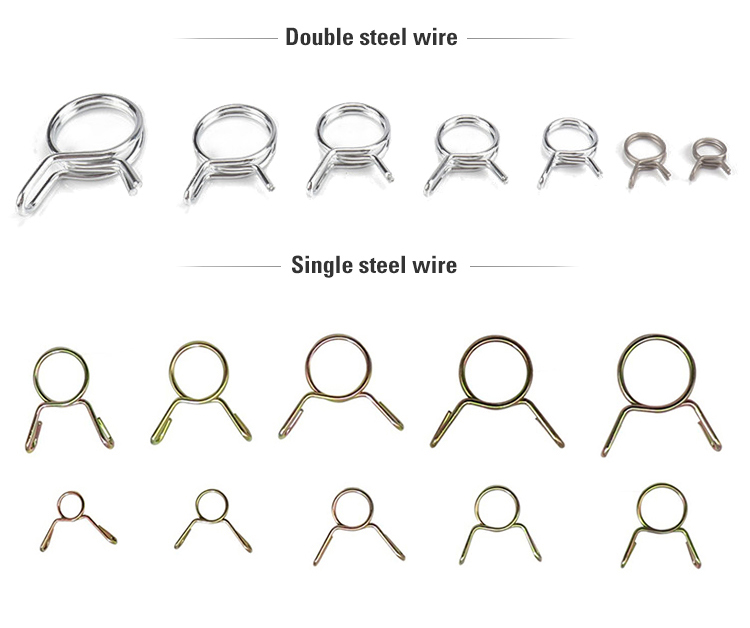
YDCT supplies both single wire and double wire spring hose clamps. The suitable structure depends on the hose material, required contact area, connection geometry, and production requirements.
Single Wire Spring Clamps
Single wire spring hose clamps use the most basic wire structure with minimum material usage. Their simple form keeps material consumption and production cost under control. They are mainly used to hold a hose securely in position in ordinary low-pressure connections. This design is suitable when the application does not require the broader contact pattern of a double wire structure.
Double Wire Spring Clamps
Double wire spring clamps use two parallel spring wires around the hose. The two-wire structure distributes contact over a wider area and provides more stable support when hose outside diameter varies within its normal tolerance. This structure is commonly considered when buyers need additional connection stability while retaining the simple installation method of a wire spring clamp.
Material and Surface Treatment Options
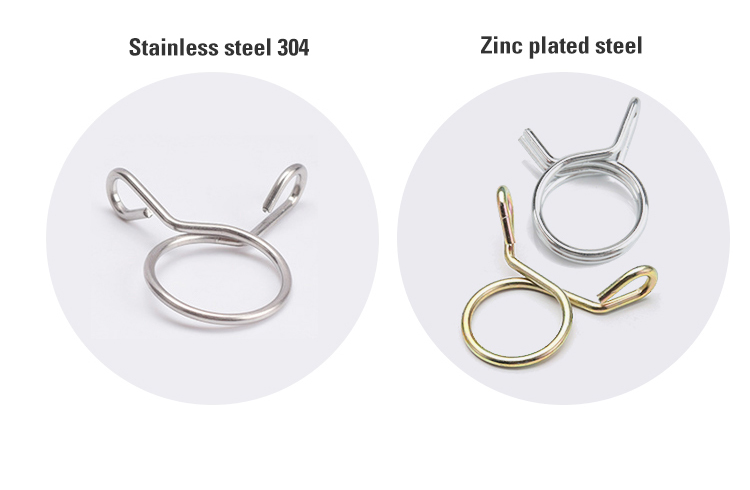
Wire spring hose clamps can be produced from carbon steel or stainless steel 304.
Carbon Steel with Zinc Plating
Carbon steel is a practical choice for high-volume projects where cost control is important. Available zinc-plated finishes include:
1. Colored zinc
2. White zinc
3. Blue-white zinc
These finishes provide basic corrosion protection for general working environments while keeping the product economical for large production runs.
Stainless Steel 304
Stainless steel 304 wire spring clamps provide better natural resistance to rust and moisture. They are suitable for applications where the clamp may regularly encounter humid conditions or outdoor exposure. Material selection should be based on the actual environment rather than appearance alone. For purchasing projects, operating conditions, moisture exposure, hose material, and expected service environment should be confirmed before the final specification is selected.
Wire Spring Clamp vs. Spring Band Clamp
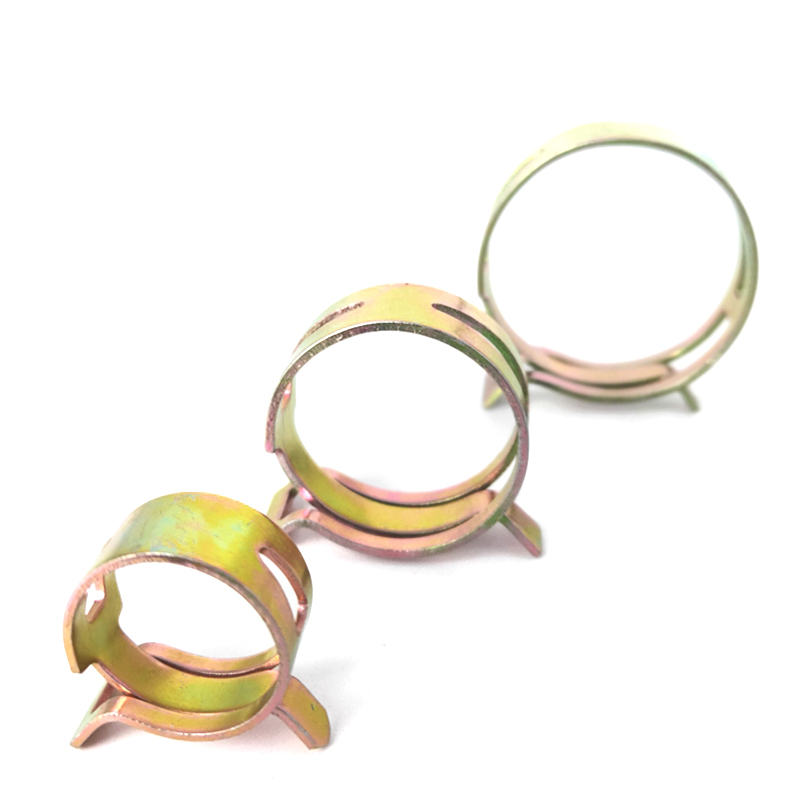
Wire spring clamps and spring band clamps serve different hose connection requirements. They should not be treated as interchangeable simply because both use spring-based structures.
YDCT recommends wire spring clamps for common low-pressure hose fastening. For high-temperature and high-pressure environments, such as demanding engine hose connections, a spring band clamp should be considered instead.
| Feature | Wire Spring Clamp | Spring Band Clamp |
|---|---|---|
| Sealing Mode | Line Contact: High local pressure, "bites" into the hose. | 360° Surface Contact: Uniform pressure distribution, superior sealing. |
| Material | Carbon Spring Steel or SS304. | 65Mn / 60Si2Mn: High-strength manganese steel for constant tension. |
| Tension Style | Fixed mechanical clamping. | Constant Tension: Automatically compensates for hose expansion/contraction. |
| Surface Finish | Zinc plating (Color/White/Blue-White). | Full range: Color Zinc, Dacromet (1000h salt spray), Nickel, Electrophoresis. |
| Hose Protection | High local pressure might mark soft hoses. | Smooth, burr-free edges prevent hose damage. |
The distinction matters particularly when working with softer hose materials. Because wire spring clamps create relatively concentrated contact, clamp diameter and hose compatibility should be verified before volume production.
Applications for Low-Pressure Hose Connections
Wire spring hose clamps are intended for straightforward hose-to-fitting connections where extreme pressure or temperature is not the main design requirement.
Oil Hose Connections
Wire spring clamps can be used on suitable low-pressure oil hoses where the main requirement is keeping the hose seated securely on its fitting. The hose material, outside diameter, fitting shape, and working conditions should be provided when confirming the clamp specification.
Air Hose Connections
Low-pressure air lines often require compact fastening components that can be installed quickly. The small structure of a wire spring clamp makes it useful where surrounding installation space is limited.
Water and Drainage Hoses
Water supply, drainage, and similar low-pressure hose systems are common applications. Double wire structures may be considered when a broader contact pattern around the hose is preferred.
Household Appliance Pipelines
Wire spring clamps can also be used on internal appliance pipelines, including suitable washing machine drainage and similar hose assemblies. Their simple installation method is especially useful where many repeated hose connections must be assembled during production.
Procurement Suggestions
Dimensional Consistency for Production Assembly
For an individual clamp, the structure appears simple. In volume production, however, consistency between batches becomes much more important.
Wire spring clamps have a relatively straightforward forming process and stable geometry. Controlling the formed diameter, wire position, and overall shape helps maintain consistent installation performance across large batches.
This is particularly useful for automated and semi-automated hose assembly lines, where excessive dimensional variation can affect installation speed and fixture compatibility.
Using basic flat pliers or suitable clamp pliers, installation can usually be completed within about two seconds. This can help reduce repetitive fastening time on high-volume assembly lines.
Before production quantities are confirmed, buyers should provide the actual hose and fitting information rather than selecting only from a nominal hose size. Sample fitting or drawing review is recommended when connection dimensions are critical.
Custom Wire Spring Hose Clamps
Standard specifications are available, while non-standard wire spring clamps can also be developed according to project requirements.
Customization can include changes to:
| Custom Item | Available Options |
|---|---|
| Wire Structure | Single wire or double wire |
| Material | Carbon steel or stainless steel 304 |
| Surface Finish | Colored zinc, white zinc, or blue-white zinc for applicable carbon steel products |
| Wire Diameter | Custom according to project requirements |
| Inner Diameter | Custom according to hose connection requirements |
| Forming Shape | Custom structures can be reviewed |
| Packaging | Bulk or customized retail/distributor packaging |
For non-standard tooling, the typical minimum order quantity is 50,000 pcs. This quantity is required to share the tooling cost.
For a new specification, providing a drawing, sample, hose outside diameter, fitting dimensions, material requirement, and intended application can make technical review more efficient.
Bulk Packaging and Supply Options
Packaging can be adjusted for different purchasing and sales models. For industrial customers, clamps can be prepared for bulk production and assembly use. For distributors and cross-border sales channels, customized box sets and mixed-size assortments can also be arranged.
Customers can specify the quantity per box, surface finish combination, and labeling format. Free packaging design support is available to help match the package format to the intended sales model.
For mixed specifications, confirm the size combination and quantity allocation before production so that packing and labeling can be prepared correctly.
Quality Control and Compliance
Wire spring clamps require more than a visual check. For repeat orders, stable forming dimensions, material control, surface treatment consistency, and batch traceability all affect purchasing reliability.
YDCT produces wire spring clamps under the IATF 16949 automotive quality management system.
The products comply with RoHS environmental requirements and MA certification standards, supporting quality control and traceability for bulk supply.
For customized projects, drawings and samples can be reviewed before volume production. This helps confirm whether the specified material, clamp geometry, and hose connection are suitable for the intended application.
FAQ
How should I measure a hose when ordering a wire spring clamp?
Do not rely only on the hose's nominal inside diameter. Measure or provide the actual outside diameter of the hose when it is installed on the intended fitting. Hose wall thickness and fitting dimensions can change the final assembled diameter. For production projects, sending a drawing or physical sample can reduce sizing errors.
Can a wire spring clamp be reused after removal?
Reuse depends on the clamp condition. If the wire has been permanently deformed, damaged, corroded, or overstretched during removal, it should not be reused. For critical production assemblies, inspect the spring action and geometry before reinstalling a previously used clamp.
Can wire spring clamps be used on soft silicone or rubber hoses?
They can be used on compatible flexible hoses, but the concentrated line contact of the wire must be considered. Excessive local pressure may leave marks on very soft hose materials. A sample fit test is recommended before confirming large-volume orders.
What information is needed for a custom wire spring clamp?
Provide the required inner diameter, wire diameter if specified, hose outside diameter, fitting dimensions, material, surface treatment, application, expected quantity, and any available drawing or sample. These details help determine whether an existing specification can be used or new tooling is required.
Should I choose carbon steel or stainless steel 304?
Carbon steel with zinc plating is a practical option for cost-sensitive volume applications in ordinary environments. Stainless steel 304 is more suitable when moisture exposure and corrosion resistance are greater concerns. The final choice should reflect the actual service environment.