
Can Flex Pipe Leaks Affect The Catalytic Converter?
A noisy flex pipe leak appears, followed by a check engine light. Could your catalytic converter be failing? A leaking flex pipe can affect catalyst diagnostics without damaging the converter itself. The connection between a flex pipe catalytic converter issue and sensor readings depends on leak location. Outside air entering the exhaust may distort oxygen sensor readings. This can affect fuel control or trigger misleading catalyst efficiency warnings. Understanding these effects helps you identify the actual problem. In this article, you'll learn how leak location influences diagnostics and when converter replacement is truly necessary.

Can a Leaking Flex Pipe Cause Catalytic Converter Problems?
A flex pipe connects exhaust sections while allowing limited engine movement. It also absorbs vibration and thermal expansion during operation. Over time, corrosion, fatigue, or mechanical stress may damage its flexible structure.
When a leak develops, exhaust gases can escape through the damaged section. Pressure changes may also draw outside air into the exhaust stream. This added oxygen can affect sensor measurements under certain operating conditions. However, a diagnostic problem does not always indicate physical converter damage.
When a Flex Pipe Leak Affects Sensor Readings Rather Than the Converter
Modern engine management systems rely on exhaust oxygen measurements. These readings help control fuel delivery and evaluate emission system performance. A leak can introduce oxygen that did not originate during combustion.
If this air reaches a monitoring sensor, its signal may become misleading. The engine computer might interpret the changed signal as abnormal catalyst performance. Yet the catalytic converter could still be working correctly.
The effect depends on several conditions:
Leak location: A leak must influence relevant sensor measurements to affect their interpretation.
Leak size: Larger openings may create greater disturbances, although small leaks can also matter.
Exhaust pressure: Pulsating flow can change how outside air enters the system.
Engine operation: Idle, acceleration, and cruising conditions produce different exhaust behavior.
Therefore, a flex pipe catalytic converter diagnosis should begin by locating the leak. Replacing the converter based only on a warning code risks overlooking the actual problem.
When an Exhaust Leak May Contribute to Actual Converter Stress
Some leaks can indirectly affect catalytic converter operating conditions. This becomes more important when they interfere with upstream fuel-control sensors.
For example, outside air may make an upstream sensor report excessive oxygen. The engine computer could respond by increasing fuel delivery. If this correction becomes excessive, exhaust composition may change significantly.
Sustained rich operation can increase catalyst temperature under certain conditions. Misfires and unburned fuel create additional risks. These problems can eventually damage catalyst materials when left unresolved.
However, a leak does not automatically produce excessive fueling. Many downstream leaks have little influence on engine fuel control. The important distinction is between misleading diagnostic data and actual catalyst deterioration. They require different tests and repair decisions.
How Does Flex Pipe Leak Location Change the Effect on Oxygen Sensors and Catalyst Diagnostics?
Leak location is often the most important diagnostic factor. Oxygen sensors measure exhaust composition at specific points in the system. A leak can affect one sensor without affecting another. A typical gasoline exhaust system includes an upstream sensor and a downstream sensor. The upstream sensor usually supports fuel control. The downstream sensor helps evaluate catalytic converter performance. Actual exhaust layouts vary between vehicles. Therefore, technicians must confirm sensor positions before interpreting a flex pipe leak.
Leaks Before the Upstream Oxygen Sensor
An upstream exhaust leak can interfere directly with fuel-control feedback. Outside air may enter through the damaged flex pipe. The upstream sensor could then detect more oxygen than expected.
The engine computer may interpret this signal as a lean mixture. During closed-loop operation, it might increase fuel delivery to compensate.
This creates several possible consequences:
Fuel trim values may increase beyond their usual operating range.
Engine fueling adjustments may become inaccurate.
Exhaust emissions may increase under certain conditions.
Catalyst operating conditions may change if incorrect corrections persist.
However, these effects are not guaranteed. They depend on sensor design, engine calibration, and leak severity. Technicians should compare fuel trim information across different operating conditions. A leak-related disturbance may become more noticeable at idle. Higher exhaust flow can sometimes reduce outside-air entry.
Leaks Between the Upstream Sensor and the Catalytic Converter
A leak after the upstream sensor creates a different situation. The primary fuel-control sensor may continue receiving normal exhaust information. Therefore, engine fuel adjustments might remain largely unaffected.
However, outside air can still enter before the catalytic converter. This changes the oxygen content reaching its internal catalyst materials. The converter uses oxygen-storage and chemical reactions to reduce harmful emissions. Unexpected oxygen entering the exhaust may influence these reactions. The resulting diagnostic effect depends on the complete sensor arrangement.
A leak in this position does not guarantee a catalyst efficiency code. It also does not prove the converter has suffered damage. Technicians should determine whether the leak influences downstream monitoring data. They should also check for unrelated combustion or sensor problems.
Leaks Between the Converter and the Downstream Oxygen Sensor
This location deserves particular attention during catalytic converter diagnostics. The downstream sensor monitors exhaust after it passes through the catalyst. A leak between these components can introduce additional oxygen before measurement. The sensor may then report a different exhaust condition than expected.
Some catalyst monitors evaluate differences between upstream and downstream sensor behavior. They use these patterns to estimate catalyst performance. Unexpected oxygen changes can interfere with that evaluation.
For example, a properly functioning converter might appear less effective during certain monitoring conditions. This can contribute to a misleading catalyst efficiency result.
However, monitoring strategies vary across vehicles. Some systems use oxygen-storage calculations or controlled mixture changes. Others evaluate signal timing and response patterns. For this reason, technicians should never diagnose converter failure from one sensor reading.
Leaks After Both Oxygen Sensors
Leaks located after both oxygen sensors usually have less diagnostic influence. They generally cannot introduce outside air into the exhaust measured by those sensors. Therefore, direct interference with catalyst efficiency monitoring becomes less likely.
However, these leaks still require attention. They can create excessive exhaust noise and unwanted emissions leakage. Escaping exhaust may also enter occupied areas under certain conditions.
A damaged connection can eventually deteriorate further through vibration and corrosion.
The following comparison summarizes how leak position changes diagnostic priorities.
Flex Pipe Leak Location | Possible Sensor Effect | Catalyst Diagnostic Impact |
Before upstream O2 sensor | May distort fuel-control feedback | Possible indirect influence |
Between upstream sensor and converter | Upstream feedback may remain normal | Depends on catalyst and sensor layout |
After converter, before downstream sensor | May distort downstream readings | Can interfere with efficiency monitoring |
After both sensors | Usually little direct effect | Generally lower diagnostic impact |
These outcomes describe possible relationships rather than universal rules. Vehicle-specific exhaust arrangements and monitoring strategies remain essential.
Can a Flex Pipe Leak Trigger P0420 or Other Catalytic Converter Fault Codes?
A leaking flex pipe can contribute to catalyst-related diagnostic trouble codes. However, the code alone cannot identify the damaged component. Codes P0420 and P0430 generally indicate catalyst system efficiency below a calibrated threshold. P0420 applies to Bank 1, while P0430 applies to Bank 2. These codes result from electronic monitoring rather than direct physical inspection. Therefore, several faults can produce similar diagnostic outcomes.
Why P0420 or P0430 Does Not Always Mean the Converter Is Bad
The engine computer evaluates catalyst performance using oxygen sensor information. A functioning converter stores and releases oxygen during exhaust treatment.
This activity changes how exhaust oxygen levels appear downstream. Monitoring systems evaluate these changes under specific operating conditions.
An exhaust leak may introduce extra oxygen into the monitored stream. This can interfere with the computer's interpretation of catalyst efficiency.
Other possible causes include:
Aging or contaminated catalytic converter materials.
Incorrect upstream or downstream oxygen sensor signals.
Exhaust leaks near relevant monitoring locations.
Engine misfires or abnormal fuel delivery.
Problems affecting sensor wiring or heating circuits.
How to Interpret Catalyst Codes Alongside Fuel Trim and Sensor Data
Fuel trim information helps technicians understand engine fueling corrections. Short-term fuel trim reflects immediate adjustments. Long-term fuel trim indicates corrections learned over time.
If an upstream leak influences oxygen readings, fuel trims may change. However, abnormal trims can also indicate intake leaks or fuel-system problems. Technicians should examine upstream and downstream sensor behavior together. They should consider operating temperature, engine load, and sensor type.
Conventional narrowband oxygen sensors and wideband air-fuel sensors behave differently. Their readings should not be interpreted using identical voltage expectations.
Freeze-frame data provides another useful diagnostic reference. It records selected operating conditions when a fault was detected. These details can help technicians reproduce the relevant conditions.
For example, a code recorded during steady cruising may require different testing conditions. A brief idle inspection might not reproduce the original monitoring fault. The goal is to identify why the monitoring system reported poor efficiency. It is not simply to find a component associated with the code.
How Can You Tell Whether the Flex Pipe or Catalytic Converter Is Causing the Symptoms?
A leaking flex pipe and a failing catalytic converter can produce overlapping symptoms. This makes diagnosis difficult when technicians rely only on driver complaints. Both problems may appear alongside warning lights or reduced performance. However, physical inspection and targeted testing can help separate them.
Physical Signs That Point Toward a Flex Pipe Leak
A damaged flex pipe often produces noticeable exhaust noise. Drivers may hear ticking, hissing, or a louder exhaust tone. These sounds may become more obvious during acceleration. They can also change as the exhaust system warms up.
Common physical warning signs include:
Visible cracks or openings in the flexible section.
Black soot deposits near damaged joints or welds.
Rust damage around corrugated metal components.
Exhaust fumes near the front exhaust assembly.
Unusual exhaust movement caused by weakened connections.
However, some openings remain difficult to see. A small crack may open further during engine movement. Technicians should inspect surrounding supports and mounting points. Excessive engine movement can place repeated stress on flexible connections.
A damaged flex pipe may also allow exhaust gases to escape near occupied areas. Suspected exhaust fumes entering the cabin require prompt attention.
Evidence That Warrants Further Catalytic Converter Testing
A damaged catalytic converter may create problems beyond exhaust leakage. A restricted converter can increase exhaust backpressure and reduce engine performance. Drivers may notice poor acceleration during higher engine loads. Severe restrictions can also interfere with normal engine operation.
However, these symptoms are not unique to catalytic converter failures. Fuel delivery problems and other exhaust restrictions can produce similar complaints.
Further tests may include:
Measuring exhaust backpressure using suitable equipment.
Reviewing relevant oxygen sensor data.
Checking catalyst monitoring results after completing required operating conditions.
Inspecting for misfires or excessive fuel delivery.
Evaluating possible catalyst contamination or internal damage.
Converter temperature measurements may provide supporting information in limited situations. They should not serve as a standalone efficiency test.
A useful diagnostic process combines physical evidence and electronic data.
Diagnostic Checklist
Locate the flex pipe and confirm its position relative to both sensors.
Inspect the flexible section, welds, and nearby joints.
Retrieve stored and pending diagnostic trouble codes.
Review freeze-frame information and fuel trims.
Test for exhaust leaks using suitable equipment.
Evaluate oxygen sensor behavior under appropriate operating conditions.
Investigate catalyst restriction or efficiency when additional evidence supports testing.
This approach reduces unnecessary parts replacement. It also helps technicians avoid overlooking multiple simultaneous faults.
What Is the Correct Diagnostic Order Before Replacing a Catalytic Converter?
The correct diagnostic sequence starts by confirming the exhaust defect. It then evaluates whether the leak explains the reported symptoms. Replacing components before completing these checks can increase repair costs. It may also leave the original fault unresolved.
Confirm and Repair the Exhaust Leak Before Condemning the Converter
Begin by inspecting the exhaust system after it has cooled. Focus on the flex pipe, nearby connections, and mounting hardware. Look for visible cracks, corrosion, and damaged welds. Examine the surrounding pipes for movement or misalignment.
If the opening remains difficult to locate, use an appropriate leak-testing method. Professional low-pressure smoke testing can help identify small openings.
Follow the testing equipment's safety instructions. Avoid excessive pressure or unsafe exhaust blockage. After confirming the defect, assess whether the flexible section requires replacement. Severe cracking or separation usually makes replacement more appropriate than temporary patching.
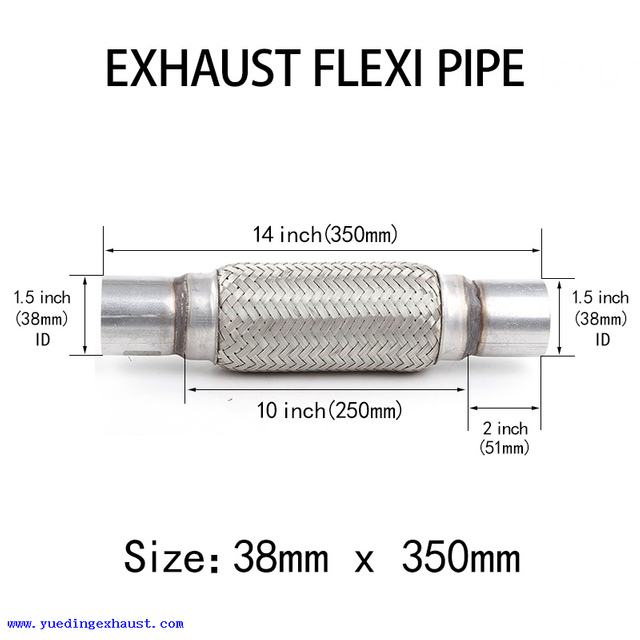
For a replacement flex pipe, several specifications deserve attention:
1. Pipe diameter: Match the relevant inlet and outlet dimensions.
2. Overall length: Confirm available installation space and connection positions.
3. Flexible section length: Allow suitable movement without excessive strain.
4. Internal construction: Select an appropriate liner or flexible configuration.
5. Connection design: Verify welding requirements, end fittings, and joint alignment.
6. Installation position: Consider heat exposure, vibration, and surrounding clearance.
A replacement should accommodate normal exhaust movement. It should not be installed under excessive compression or tension.
At Yueding, we offer exhaust flex pipes for different exhaust assembly requirements. We can review existing specifications, OE numbers, samples, or drawings to help identify suitable replacements.
A properly selected component helps restore exhaust sealing and flexibility. Correct installation also reduces the risk of repeated joint failure.
Verify Catalyst Monitoring Results After the Repair
Leak repair should not end when the exhaust becomes quieter. Technicians should verify that the repaired connection is properly sealed. They should also confirm that exhaust supports remain secure. Nearby components must have adequate clearance during engine movement.
Next, review fuel trims and relevant oxygen sensor signals. Compare the results against expected vehicle-specific behavior. Some catalyst monitors require particular driving conditions before completing their tests. These may involve specific temperatures, speeds, or operating loads.
Follow the vehicle's prescribed diagnostic procedure rather than relying on a universal driving distance. If the efficiency code returns, continue investigating the remaining possibilities. Check sensor operation, fuel-control behavior, and engine combustion.
Persistent faults may justify more detailed catalytic converter testing. However, they still do not establish converter failure without supporting evidence. For workshops, recording repair results can help demonstrate the completed diagnostic process. It also supports clearer communication about additional repairs.
Conclusion
A flex pipe leak can affect catalytic converter diagnostics without necessarily damaging the converter. Its location determines how oxygen sensor readings and catalyst monitoring may change. Leaks before the upstream sensor may affect fuel control. Leaks near downstream sensors can distort catalyst efficiency readings. Before replacing the converter, confirm the leak and inspect sensor data. Repair exhaust defects first, then verify system performance. Persistent fault codes require further diagnosis. Zhejiang Yueding Corrugated Tube Co., Ltd. provides exhaust flex pipes designed to absorb vibration and accommodate engine movement. We offer replacement solutions to support reliable exhaust connections and long-term system performance.
FAQ
Q: Can a Flex Pipe Catalytic Converter Leak Cause Permanent Damage?
A flex pipe catalytic converter leak does not automatically cause permanent damage. However, upstream leaks may affect fuel control, potentially increasing catalyst stress during prolonged operation.
Q: Can a Flex Pipe Catalytic Converter Leak Trigger a P0420 Code?
Yes, a flex pipe catalytic converter leak can contribute to P0420. Outside air may distort oxygen sensor readings, causing misleading catalyst efficiency results without actual converter failure.
Q: How Does a Flex Pipe Catalytic Converter Leak Affect O2 Sensors?
A flex pipe catalytic converter leak may introduce outside air into the exhaust. Depending on its location, this can distort upstream fuel-control readings or downstream catalyst monitoring signals.
Q: Will Replacing a Leaking Flex Pipe Fix a Catalytic Converter Code?
Replacing a leaking flex pipe may resolve a P0420 code if the leak caused misleading readings. Persistent codes require further oxygen sensor, fuel-control, and catalyst testing.
Q: How Can You Tell Whether a Flex Pipe Leak or Catalytic Converter Is Failing?
A flex pipe leak often causes hissing, exhaust noise, or visible soot. Converter problems may involve restricted exhaust flow or persistent efficiency codes. Proper testing distinguishes them.




About Yueding
YUEDING manufactures stainless steel exhaust flexible connectors, clamps, metal bellows, and selected automotive exhaust components under ISO and IATF quality systems. With in-house production, inspection, and packaging capabilities, we support bulk orders, standard-size inventory, and customized branding for global B2B customers.
Reliable Delivery
Stable production planning, standard-size inventory, and batch shipping support help make delivery more predictable.

Factory Direct
Production, inspection, and packaging are managed in-house, making communication, quality control, and customization more efficient.

Integrated Supply
We supply flex pipes, clamps, metal bellows, and selected exhaust components to support related purchasing needs from one manufacturer.

