
How To Choose Best Exhaust Flex Pipe
The best exhaust flex pipe is not simply the thickest, most expensive, or largest connector available. It is the one that fits the actual exhaust diameter, absorbs the required movement, tolerates the operating environment, and matches the installation method without forcing the flexible section into permanent tension or compression. A passenger car, turbocharged vehicle, diesel truck, generator, and industrial exhaust line can therefore require very different designs. Before comparing products, treat diameter, flexible length, internal structure, material, connection style, vibration level, and available installation space as one specification rather than separate decisions.
Quick Answer: What Should You Check First?
To choose the best exhaust flex pipe, start with the existing exhaust system rather than a generic vehicle description. Confirm the real pipe dimensions and available space first, then select the construction according to vibration, thermal movement, exhaust conditions, and connection method. Exhaust flex pipes are produced in multiple braid, interlock, nipple, flange, and universal configurations for automotive, commercial vehicle, and machinery applications.
Selection Question | What to Confirm | Why It Matters |
|---|---|---|
Will it physically fit? | Pipe diameter, overall length, flex-body length, end style | Incorrect dimensions create sealing and installation problems. |
How much movement is present? | Engine vibration, thermal expansion, alignment change | The connector must flex without being constantly stretched or compressed. |
How demanding is the application? | Passenger car, turbo system, diesel truck, generator, equipment | Different loads favor different liner and reinforcement structures. |
How will it be installed? | Weld-in, clamp-on, nipple-end, or flange-mounted | The connection method affects fit, sealing, servicing, and required space. |
What environment will it face? | Heat, road salt, moisture, vibration, exposure | These conditions influence material and structural choices. |
What Makes the Best Exhaust Flex Pipe for a Specific Application?
A useful selection hierarchy is fit first, operating condition second, construction third, and material fourth. Buyers sometimes reverse that order by choosing a stainless grade or a “heavy-duty” label before verifying the joint geometry. A strong component can still fail prematurely when it is too short for the required movement, installed at an angle, or forced to compensate for an exhaust system that is not properly supported.
Begin by identifying the role of the exhaust system flex pipe. Is it primarily isolating normal engine vibration in a passenger vehicle? Is it located in a higher-load diesel exhaust system? Does it need to accommodate movement between an engine and stationary exhaust piping? Or is it being selected as a repair component for a damaged original joint? These scenarios do not place identical demands on the flexible section.
The product should also fit the surrounding system. Check clearance around the braid, nearby brackets, heat-sensitive components, hanger positions, and the rigid pipe on both sides. A flexible connector is intended to absorb controlled movement; it should not become the only support for excessive exhaust weight or severe misalignment.
For buyers comparing broader configurations, Stainless Steel Flex Pipes include different braid, liner, end, and connection arrangements rather than one universal construction. The practical goal is therefore not to identify one “strongest” pipe, but to match the structure to the load it will actually experience.
Choose the Right Flex Pipe Construction for Heat and Movement
Construction has a major influence on how an exhaust flex connector reacts to vibration, gas flow, repeated movement, and mechanical loading. Products that appear similar externally may use different internal arrangements, so appearance alone is not a reliable selection method.
Outer Braid and Inner Braid Designs
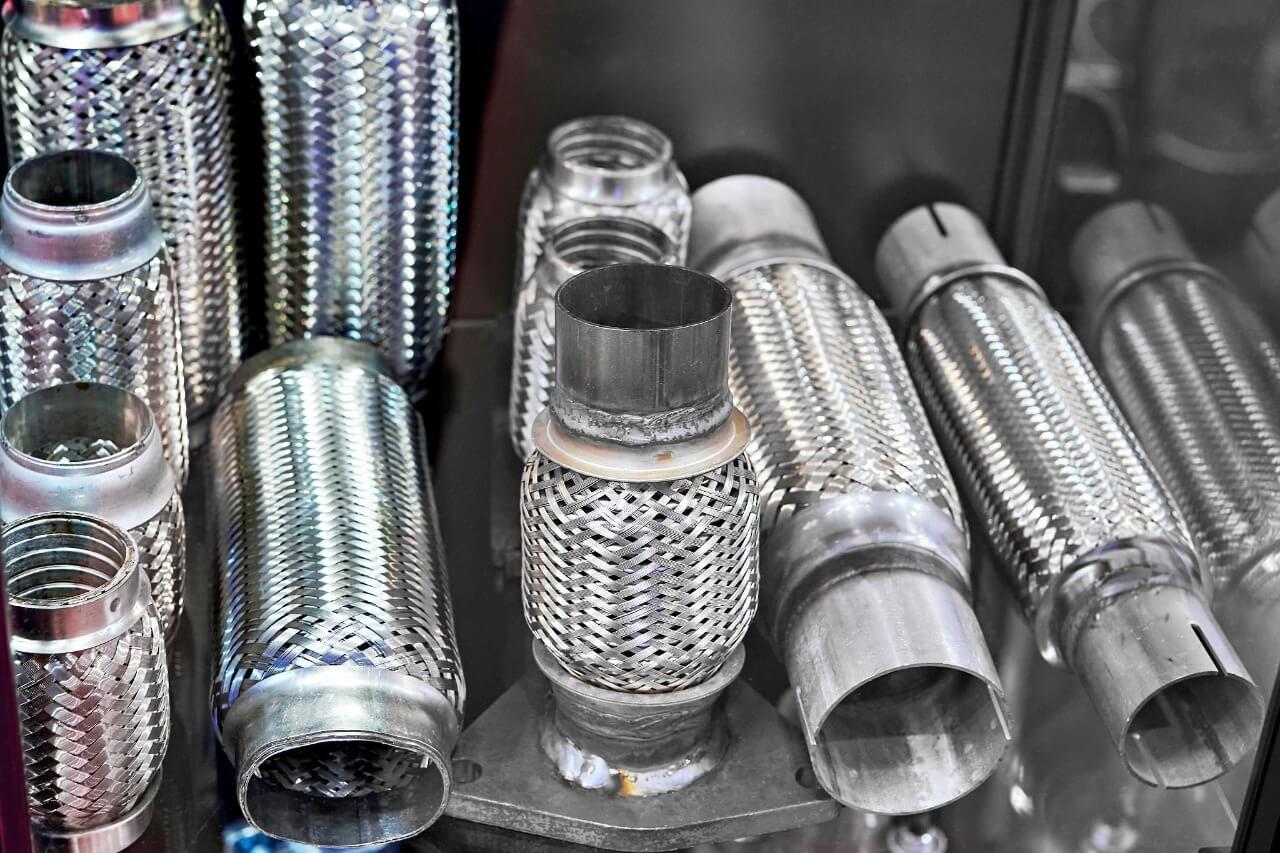
A braided outer layer surrounds the corrugated flexible section and helps restrain excessive movement while protecting the bellows. Some configurations also use an inner braid. These structures are widely suited to normal automotive replacement where vibration isolation, flexibility, compact dimensions, and reasonable cost need to be balanced.
Interlock-Lined Flex Pipes
An interlock liner adds a formed metal layer inside the flexible section. It is often considered when exhaust flow, internal support, temperature exposure, or sustained operating loads are more demanding. Trucks, diesel systems, turbo-related applications, and equipment can therefore justify a more reinforced internal structure than a lightly loaded passenger-car repair. Yueding's range includes braided, interlock, mesh, nipple, and custom flexible configurations.
Heavy-Duty and Flanged Connectors
For machinery, generators, commercial vehicles, or installations that require removable bolted connections, a reinforced braided connector with suitable flanges can simplify assembly and later servicing. A flange design must still match the bolt pattern, mating faces, diameter, and available movement; the presence of a flange does not automatically make a connector suitable for every heavy-duty system.
Yueding's Heavy-Duty Braided Flex Pipe combines a corrugated flexible tube, external braid, and customizable flange arrangements for truck, generator, machinery, and other demanding exhaust connections.
Construction | Good Starting Point For | Check Before Buying |
|---|---|---|
Braided flex pipe | General automotive repair and vibration isolation | Diameter, braid condition, movement, and body length |
Inner-braid design | Passenger cars and moderate-duty exhaust systems | Heat level and required internal support |
Interlock-lined design | Diesel, turbo, truck, and higher-load applications | Required flexibility, flow path, heat, and vibration |
Flanged heavy-duty design | Generators, machinery, commercial systems | Flange geometry, alignment, support, and service access |
Buyers who need several structures or sizes can compare the broader Exhaust Flex Pipe Range rather than treating all flexible connectors as interchangeable.
How Do You Choose 2.5, 3, 4, and 5 Inch Exhaust Flex Pipe?
Diameter should normally follow the actual exhaust pipe being connected. Do not increase or reduce the flex pipe diameter simply because a larger size appears stronger or offers more flow. An unnecessary step in diameter can complicate fabrication, create sealing problems, and change how the joint fits the surrounding exhaust layout.
Measure Diameter and Length as Separate Specifications
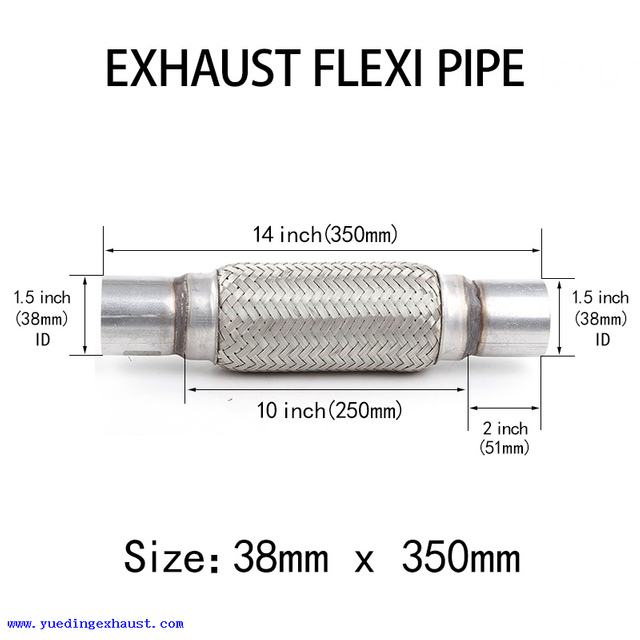
Measure the relevant pipe outside diameter and determine whether the connector is intended to slip over the pipe, fit between sections, accept a welded collar, or use another interface. Then measure both the available overall length and the flexible body length. Yueding's existing sizing guidance covers common automotive diameters as well as larger specifications used in trucks, machinery, generators, and industrial exhaust systems.
A 2.5 inch flexible exhaust pipe is commonly encountered in automotive and truck-related systems, but the diameter alone does not confirm compatibility. Yueding's 2.5-Inch Flex Pipe, for example, is a braided stainless configuration available with different length and end options.
A 3 inch exhaust flex pipe is often considered in larger automotive, performance, light-commercial, and diesel layouts. A 4 inch exhaust flex pipe or 4 inch diesel exhaust flex pipe moves further into commercial vehicle and high-flow territory, while a 5 inch exhaust flex pipe is more associated with large diesel and heavy-duty exhaust systems. These are application tendencies, not universal sizing rules. The original pipe dimensions and system design remain the deciding factors.
Length deserves equal attention. A connector that is too short may have insufficient active movement, while an unnecessarily long unit can create packaging and support problems. Select enough flexible length for the required movement without using the flex section to correct major pipe misalignment.
When Is a Universal Exhaust Flex Pipe the Right Choice?
A universal exhaust flex pipe is useful when the system does not require an exact vehicle-specific assembly and the installer can accurately match the diameter, length, end connection, and available space. Universal does not mean “fits every vehicle.” It means the component can be incorporated into multiple exhaust layouts when its specifications match the application.
This distinction matters for repair shops, distributors, and custom exhaust fabricators. A universal flex pipe can reduce the need to stock a dedicated assembly for every vehicle, but the installer must still confirm fit and operating conditions. A universal part is a poor choice if adapting it requires severe bending, excessive reducers, permanent compression, or an unsuitable connection method.
Weld-In Versus No-Weld Universal Designs
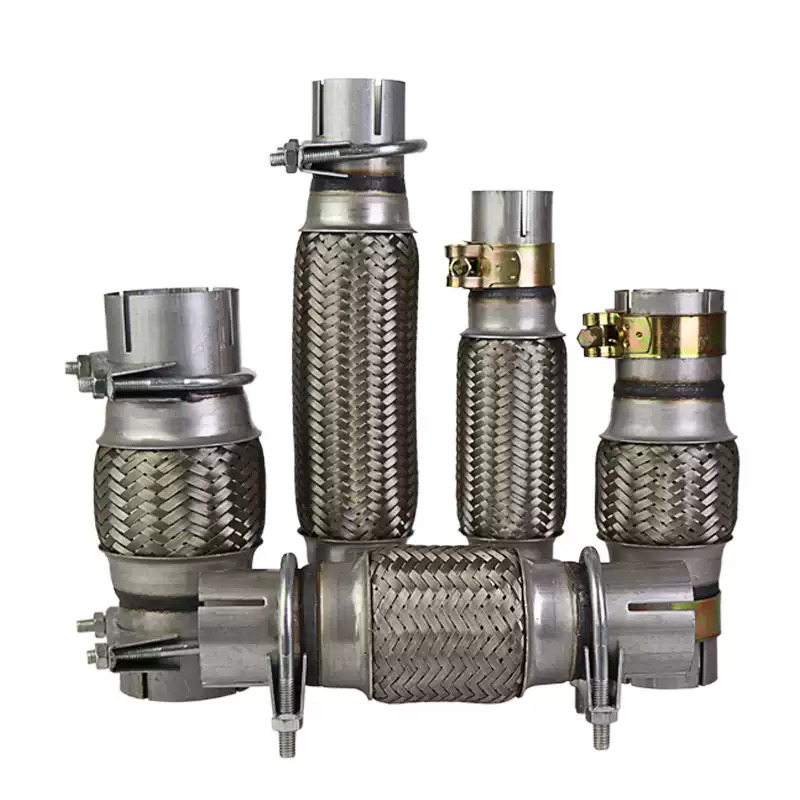
Weld-in designs are useful where a permanent fabricated connection is appropriate and qualified installation is available. Clamp-based options can simplify service work in systems designed to accept them, but they require the correct pipe overlap, clamp arrangement, alignment, and installation space.
For applications specifically requiring a clamp-based connection, Yueding's No-Weld Flex Pipe Kit combines a corrugated flexible connector with a pre-fitted clamping arrangement and is offered in multiple dimensions and materials.
For fleet or bulk purchasing, decide whether “universal” refers only to diameter or to a standardized combination of diameter, length, collar design, braid structure, and installation method. Defining those variables reduces the chance that one nominal size is expected to cover incompatible systems.
Material, Installation, and Buying Mistakes That Affect Flex Pipe Life
Stainless grade matters, but it should not be evaluated independently from construction and environment. Different parts of a flexible connector may perform different functions: the bellows absorbs movement, braid restrains and protects the flexible body, an internal liner manages the exhaust flow path, and collars or flanges provide the mechanical interface. Yueding lists multiple stainless material options across its exhaust flexible pipe range, including 201, 304, 409, and 316 depending on product configuration and requirement.
For general purchasing, 304 stainless is frequently considered where corrosion resistance and durability need to be balanced. More corrosion-resistant grades may be relevant in harsher environments, while other stainless or mixed-material configurations can be appropriate where fabrication, cost, and system compatibility are the priority. Avoid paying for a higher material grade while ignoring a structural mismatch that will expose the component to movement it was not designed to absorb.
Common Selection Mistakes
Buying by diameter only: the correct diameter with the wrong overall or flexible length can still be unusable.
Assuming larger is better: a 4 or 5 inch pipe should not replace a smaller connector unless the exhaust system is designed around that diameter.
Choosing “heavy-duty” without defining the load: heat, vibration, movement, corrosion, and mounting conditions are separate variables.
Using the flex section to correct alignment: a connector installed under constant side load or twist has less ability to absorb normal operating movement.
Ignoring nearby supports: damaged hangers, mounts, or unsupported exhaust weight can overload a new flex pipe.
Treating clamp-on and weld-in parts as equivalent: each connection method has different geometry and installation requirements.
Buying Checklist for the Best Exhaust Flex Pipe
Specification | Information to Confirm |
|---|---|
Diameter | Actual mating pipe diameter and whether ID or OD controls the connection |
Length | Overall length plus active flexible-body length |
Structure | Braid, inner braid, interlock, reinforced, or flanged arrangement |
Application | Vehicle, diesel truck, generator, machinery, or other exhaust system |
Operating conditions | Vibration, thermal movement, corrosion exposure, and installation position |
End connection | Weld-in, clamp-on, nipple, flange, or custom fitting |
System condition | Alignment, mounts, hangers, pipe support, and surrounding clearance |
For repeat orders | Drawing, sample, dimensional list, structure, material, and quantity by size |
Conclusion
The best exhaust flex pipe is the connector that matches the whole operating system, not the product with the most aggressive specification. Confirm diameter and length first, then evaluate movement, heat, internal structure, material, installation style, surrounding supports, and maintenance requirements together. Universal designs can work well when their dimensions and connection method genuinely match the system, while diesel, heavy-duty, and industrial applications may require more reinforced structures. Zhejiang Yueding Corrugated Tube Co., Ltd. is a manufacturer and supplier of exhaust flex pipes and related flexible exhaust connection components with in-house forming, braiding, welding, inspection, and assembly capabilities.
Frequently Asked Questions
What is the best exhaust flex pipe for a universal replacement?
The best universal replacement is one that matches the existing pipe diameter, available overall length, required movement, end connection, and operating environment. “Universal” should never be interpreted as automatic vehicle compatibility. Measure the existing system and check installation space before choosing a part.
Is 304 stainless steel always the best material for an exhaust flex pipe?
No single stainless grade is ideal for every application. 304 is a practical option for many exhaust flex pipe components because it balances corrosion resistance and durability, but material selection should also consider temperature, corrosion exposure, component function, fabrication requirements, and cost. Structure and installation can affect service life as much as material grade.
Should I choose a 3 inch, 4 inch, or 5 inch exhaust flex pipe?
Match the flex pipe to the actual exhaust diameter rather than selecting size from engine type alone. Three-inch sizes are often seen in larger automotive and light-commercial systems, while 4- and 5-inch diameters are more common in larger diesel and heavy-duty exhaust layouts. Actual pipe dimensions remain the primary selection criterion.
Does a longer exhaust flex pipe absorb more movement?
A longer active flexible section can provide more movement capacity in some designs, but simply installing the longest available pipe is not a reliable rule. The connector still needs enough surrounding clearance, appropriate support, and the correct geometry. Its movement capability should suit the exhaust layout rather than compensate for poor alignment.
Can a no-weld universal flex pipe replace any welded connector?
No. A no-weld design requires compatible pipe dimensions, sufficient overlap or connection area, correct clamp geometry, suitable clearance, and an application where the clamped joint can meet the system's mechanical and sealing requirements. Some exhaust layouts are better suited to welded, flanged, or application-specific connections.




About Yueding
YUEDING manufactures stainless steel exhaust flexible connectors, clamps, metal bellows, and selected automotive exhaust components under ISO and IATF quality systems. With in-house production, inspection, and packaging capabilities, we support bulk orders, standard-size inventory, and customized branding for global B2B customers.
Reliable Delivery
Stable production planning, standard-size inventory, and batch shipping support help make delivery more predictable.

Factory Direct
Production, inspection, and packaging are managed in-house, making communication, quality control, and customization more efficient.

Integrated Supply
We supply flex pipes, clamps, metal bellows, and selected exhaust components to support related purchasing needs from one manufacturer.

