
What Is A Flex Pipe in Car Exhaust
If you look underneath a car and find a short woven or corrugated metal section interrupting an otherwise rigid exhaust pipe, you may be looking at an exhaust flex pipe. Its job is not simply to carry exhaust gas. It provides controlled flexibility between components that do not remain perfectly stationary relative to one another. That distinction matters when identifying a failed part or choosing a replacement: the correct flex section must fit the pipe, tolerate movement, and avoid transferring excessive stress into nearby joints.
Quick Answer
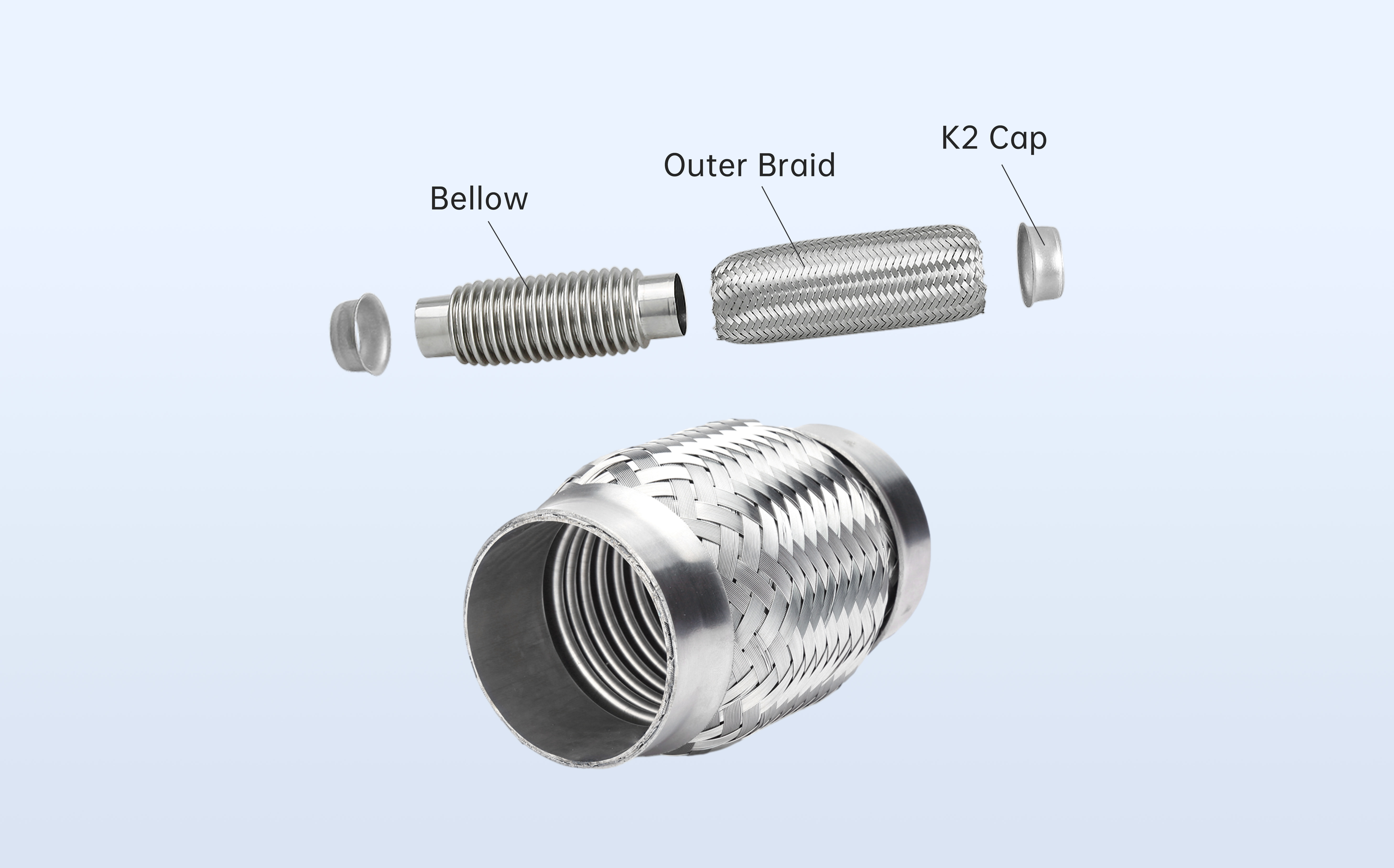
An exhaust flex pipe is a flexible metal connector installed within a vehicle's exhaust system. It allows limited movement while exhaust gas continues through the pipe. This helps isolate engine vibration, accommodate thermal movement, and reduce stress on rigid exhaust tubing, welds, manifolds, and connected components. Many designs use a corrugated stainless steel bellows with an external braid, while other versions add an inner braid, interlock liner, mesh cover, or extended end tubes.
What Is a Flex Pipe in a Car Exhaust System?
A car exhaust system combines parts attached close to the engine with longer piping supported underneath the vehicle. Those sections experience vibration, heat cycles, engine movement on its mounts, and movement between different parts of the vehicle. A completely rigid connection can concentrate repeated stress at welds, flanges, or other joints.
The exhaust flex pipe creates a controlled flexible zone. Instead of requiring every connected pipe to move together as one rigid assembly, the flex section can bend or change length slightly within its intended working range. Exhaust gas still passes through the component, so flexibility must be provided without turning the section into an uncontrolled loose hose.
Location depends on the exhaust layout. It is often placed relatively close to the engine or in another area where relative movement needs to be isolated. Some exhaust systems can use more than one flexible section. The important point is its function rather than assuming that every vehicle must position the part at exactly the same distance from the manifold or catalytic converter.
An exhaust flex pipe is also different from a catalytic converter or muffler. A converter is intended to treat exhaust pollutants, while a muffler primarily manages exhaust noise. The flex section is fundamentally a mechanical movement-control component within the gas path.
How Does an Exhaust Flex Pipe Work?
The easiest way to understand a flex pipe for exhaust applications is to consider the types of movement that a rigid tube must otherwise resist.
Engine vibration and movement
An engine is mounted so that some movement can occur rather than transmitting all vibration directly into the vehicle structure. Acceleration, deceleration, idle vibration, and changes in engine load can therefore create relative motion between the engine-side exhaust connection and downstream piping. A suitable exhaust flex pipe allows part of this movement to occur without forcing the rigid exhaust system to absorb all of it. Flexible exhaust sections are specifically used to damp movement and vibration within exhaust assemblies.
Thermal expansion and contraction
Exhaust components repeatedly heat and cool. Metal dimensions change with temperature, and different sections do not necessarily heat at identical rates. The flexible section provides compliance so some of this dimensional change can be accommodated rather than concentrated at a rigid joint.
Small alignment changes
A flex section can tolerate limited movement caused by normal system operation, but it should not be treated as a substitute for badly aligned tubing. Excessive bending, a severe offset, incorrect hanger position, or forced installation can keep the flex pipe permanently loaded in one direction. More flexibility is therefore not automatically better. A good installation lets the component work around a neutral position instead of using it to pull two poorly aligned pipes together.
Do I Need a Flex Pipe on My Exhaust?
If a vehicle was designed with an exhaust flex pipe, replacing that section with a completely rigid tube can remove the movement allowance engineered into the original exhaust layout. The nearby pipes may still fit initially, but vibration and thermal movement must then be absorbed somewhere else in the system.
For a custom exhaust, the answer depends on system geometry rather than a universal rule that every exhaust must use the same type or number of flexible connectors. Consider relative engine movement, exhaust support locations, pipe length, thermal movement, turbo or manifold connections, available installation space, and the direction in which movement occurs.
This also explains why the question “do I need a flex pipe on my exhaust?” should not be answered only by looking at pipe diameter. A 2-inch rigid tube and a 2-inch flexible connector may share a nominal size while performing very different mechanical functions.
A properly selected flex section should provide enough compliance for the intended movement while remaining stable in the exhaust stream. It should not be expected to correct severe misalignment, replace an elbow, compensate for failed mounts, or support the weight of an incorrectly hung exhaust system.
What Is Inside an Exhaust Flex Pipe?
The visible braid is only one part of many exhaust flex pipe designs. A typical construction can combine corrugated bellows, an outer braid or mesh, retaining caps, and sometimes an inner braid or interlock liner. End nipples or other connection sections may also be added for installation. Yueding's product range includes outer-braid, inner-braid, interlock, mesh-braid, and extended-end configurations for different exhaust applications.
Flex Pipe Structure | Main Design Characteristic | Selection Consideration |
|---|---|---|
Outer braid over bellows | Basic flexible construction with external braid protecting and stabilizing the bellows | Useful where straightforward movement isolation is required |
Inner and outer braid | Adds an internal braided layer to the flexible assembly | Consider when internal protection and flow behavior are part of the design requirement |
Interlock liner | Includes a flexible internal metal liner | Can be considered for more demanding exhaust-flow or operating conditions |
Mesh or thin mesh braid | Uses a lighter external mesh arrangement around the corrugated section | Suitable where flexibility and a compact automotive construction are priorities |
Flex pipe with nipples | Adds straight extension tubes to the flexible body | Changes installation length and the available connection area |
For example, an automotive thin mesh flex pipe uses corrugated bellows with an external thin mesh structure and is offered for passenger-vehicle exhaust applications where flexibility is a key consideration.
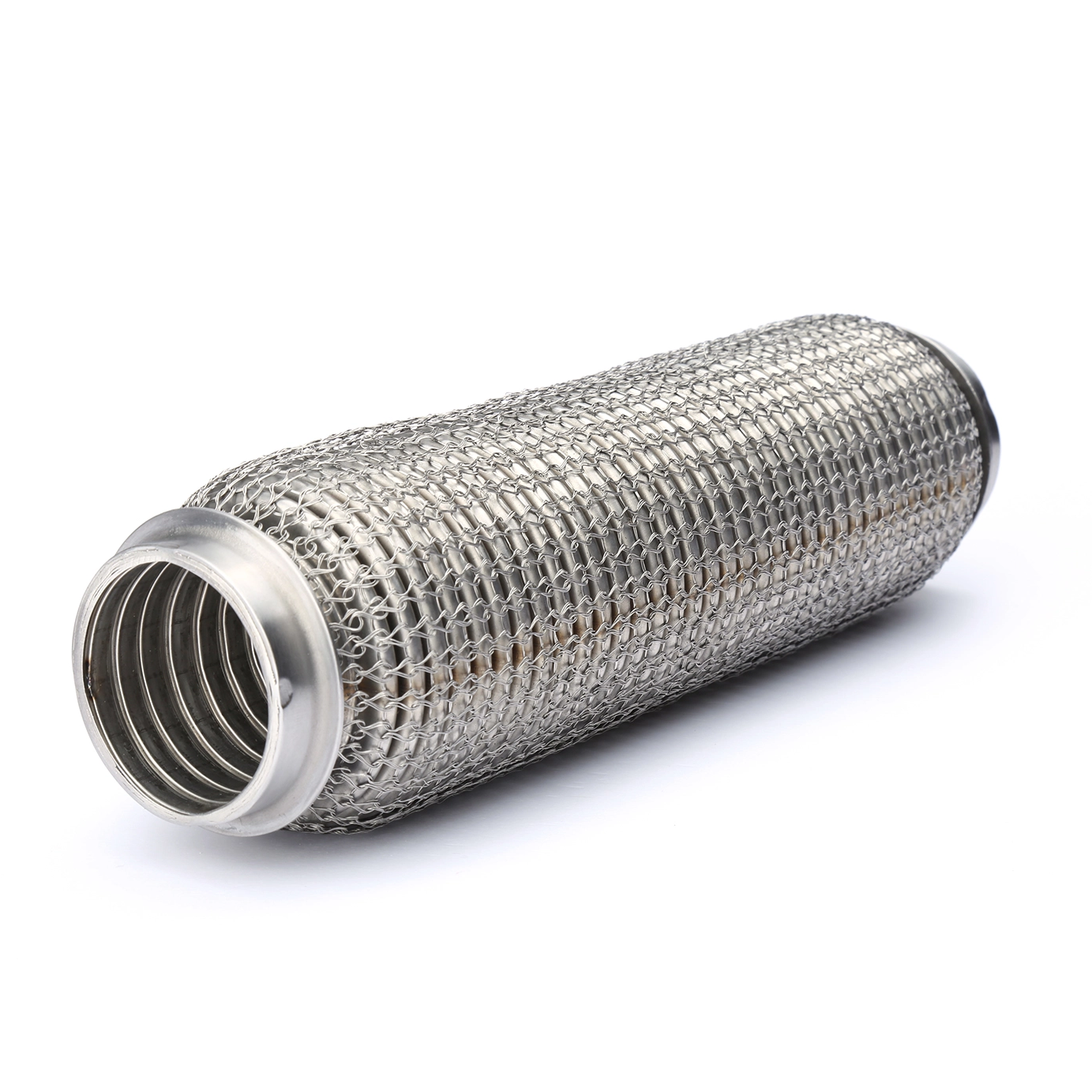
Buyers comparing exhaust flexible pipes should therefore avoid treating braid appearance as the only selection criterion. Structure, material, pipe dimensions, end design, expected movement, and operating conditions need to be evaluated together.
How Do You Know if a Car Exhaust Flex Pipe Is Bad?
A damaged car exhaust flex pipe commonly becomes noticeable because it no longer maintains a sealed, mechanically stable flexible connection. Noise may increase, the braid or bellows may show physical damage, soot can appear around a leak, or the flexible section may become visibly distorted.
What You Notice | What It May Indicate | What Else Should Be Checked |
|---|---|---|
Hissing, ticking, or louder exhaust sound | Possible leak in the flexible section or nearby joint | Welds, flanges, clamps, and surrounding pipe |
Torn braid or cracked bellows | Mechanical fatigue, corrosion, impact, or excessive movement | Engine mounts, alignment, hangers, and road-impact damage |
Repeated flex pipe failure | The replacement may be underspecified or continuously preloaded | Pipe angle, flex length, mount condition, and installation position |
Exhaust odor around or inside the vehicle | Possible exhaust leak requiring prompt inspection | Entire exhaust path and vehicle floor/body sealing |
One of the most useful diagnostic distinctions is the difference between a failed component and the condition that caused it to fail. Installing another exhaust flex pipe without checking excessive engine movement, damaged hangers, poor alignment, or impact damage can leave the new part exposed to the same abnormal loading.
Exhaust odor inside a vehicle should be taken seriously. Carbon monoxide is present in vehicle exhaust, and even a small exhaust-system leak can contribute to CO accumulation inside a car.
How to Choose a Replacement Exhaust Flex Pipe Without Guessing
Once you understand what a flex pipe is, replacement selection becomes a specification problem rather than a visual-matching exercise. The correct exhaust flex pipe must fit the existing tubing and provide an appropriate flexible section for the application.
1. Confirm the actual pipe diameter
Do not choose only from the vehicle class or engine size. Measure the relevant pipe dimensions and determine how the replacement connects to the existing exhaust. Nominal descriptions can be misleading when one part is intended to slide over another while another configuration is designed for butt welding.
2. Separate overall length from flexible-body length
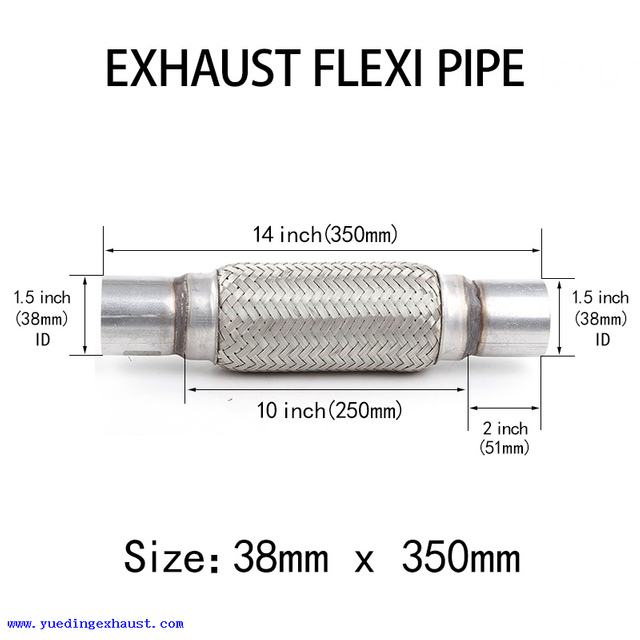
The total component length and the length of the corrugated flexible section are not interchangeable specifications. A pipe with long end nipples may have the same overall length as another part but a much shorter flexible body, changing the amount and distribution of movement it can accommodate.
3. Match the connection style
Determine whether the application requires plain ends, extended nipples, flanges, clamps, couplers, or another connection arrangement. Connection choice influences installation space and how load enters the flexible section.
4. Choose structure for the operating conditions
Outer-braid, inner-braid, interlock, and mesh configurations are not merely cosmetic variations. Consider vibration, exhaust flow, heat exposure, corrosion conditions, packaging space, and expected service environment. Yueding offers an exhaust flex pipe range with multiple braid, liner, and end configurations for automotive, commercial-vehicle, and related exhaust applications.
5. Treat diameter as only one part of fitment
A 2.5 inch flex pipe, for example, still requires the correct length, braid or liner structure, end configuration, and installation geometry. Choosing by “2.5 inch” alone does not establish compatibility.
Replacement Buying Checklist
Actual inlet or pipe diameter
Overall component length
Length of the flexible body
Available installation space
Outer braid, inner braid, mesh, or interlock requirement
Material requirement for the operating environment
Plain ends, nipples, flanges, clamps, or other connections
Direction and amount of normal system movement
Condition of engine mounts and exhaust hangers
Signs of misalignment, corrosion, or impact that could cause repeat failure
Conclusion
An exhaust flex pipe is a controlled flexible connection, not simply a softer version of ordinary exhaust tubing. Its purpose is to accommodate normal relative movement while maintaining the exhaust path and reducing stress on rigid components. Correct replacement therefore depends on geometry, construction, connection style, and operating conditions together—not diameter alone. Zhejiang Yueding Corrugated Tube Co., Ltd. is a manufacturer of stainless steel exhaust flex pipes and related flexible connection components, with in-house forming, braiding, welding, inspection, and other production processes.
FAQ
Is an exhaust flex pipe the same as a normal exhaust pipe?
No. A rigid exhaust pipe primarily carries exhaust gas between components, while an exhaust flex pipe is specifically constructed to permit controlled movement. The flexible section usually incorporates corrugations and braid or another reinforcing structure.
Can a rigid pipe replace a flex pipe on a car?
If the original exhaust system was designed with a flexible section, replacing it with rigid tubing removes that movement allowance. This can transfer vibration and thermal stress into other joints. Vehicle-specific exhaust geometry should be preserved unless the system is being properly redesigned.
Can a car have more than one flex pipe?
Yes. The number and location depend on engine configuration and exhaust layout. A vehicle can use separate flexible sections where different exhaust branches or connections require movement isolation.
Does an exhaust flex pipe make the exhaust louder?
A correctly functioning flex pipe is not primarily a sound-modification component. A damaged or leaking flex section, however, can make the exhaust noticeably louder or produce ticking and hissing noises.
Why would a new car exhaust flex pipe fail again?
Repeat failure can indicate more than a poor replacement part. Excessive engine movement, incorrect exhaust alignment, damaged hangers, insufficient flexible length, road impact, corrosion, or an unsuitable structure can continue loading the replacement.
What information should I provide when ordering an exhaust flex pipe?
Useful information includes pipe diameter, overall length, flexible-body length, end configuration, preferred structure, material requirements, application conditions, and photos, samples, drawings, or original references where available. These details reduce the risk of selecting a part that fits by diameter but not by function.




About Yueding
YUEDING manufactures stainless steel exhaust flexible connectors, clamps, metal bellows, and selected automotive exhaust components under ISO and IATF quality systems. With in-house production, inspection, and packaging capabilities, we support bulk orders, standard-size inventory, and customized branding for global B2B customers.
Reliable Delivery
Stable production planning, standard-size inventory, and batch shipping support help make delivery more predictable.

Factory Direct
Production, inspection, and packaging are managed in-house, making communication, quality control, and customization more efficient.

Integrated Supply
We supply flex pipes, clamps, metal bellows, and selected exhaust components to support related purchasing needs from one manufacturer.

