
How Exhaust Flex Pipes Are Manufactured
An exhaust flex pipe has to perform two jobs that normally work against each other: remain flexible enough to absorb vibration and movement while staying structurally stable in a hot exhaust line. That balance is created during manufacturing, not simply by choosing stainless steel. Corrugation geometry, braid construction, liner type, end connections, welding accuracy, and dimensional control all influence how the finished component behaves. A well-controlled exhaust flex pipe manufacturing process therefore starts with the intended application and continues through forming, braiding, assembly, welding, inspection, and final specification verification.
Quick Answer: How Is an Exhaust Flex Pipe Made?
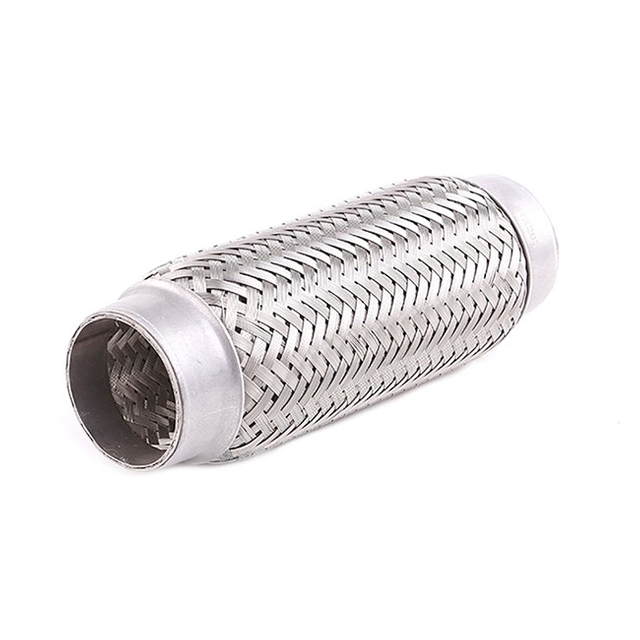
In a typical exhaust flex pipe manufacturing process, stainless steel tubing is prepared and formed into corrugated bellows. Depending on the required construction, an inner braid or interlock liner may be added, followed by an external stainless steel braid or mesh. Caps, nipples, extension tubes, or flanges are then positioned and welded to create the complete exhaust flex joint. Dimensional, weld, sealing, pressure, flexibility, or fatigue checks can then be applied according to the product design and order requirements.
Manufacturing Stage | Main Purpose | What It Influences |
|---|---|---|
Material preparation | Prepare tubing, strip, wire, and end components | Corrosion resistance, formability, cost, consistency |
Bellows forming | Create the corrugated flexible section | Movement capability, stiffness, fatigue behavior |
Liner and braid production | Add internal or external structural layers | Bellows protection, flexibility, flow behavior |
Assembly and welding | Join caps and end connections | Fitment, sealing, alignment, structural integrity |
Inspection and testing | Verify production against the required specification | Batch consistency and application suitability |
What Goes Into an Exhaust Flex Pipe Before Production Starts?
The manufacturing sequence cannot be separated from product design. Two pieces of stainless steel flexible exhaust tubing with the same outside appearance may use different stainless grades, bellows dimensions, braid structures, internal liners, overall lengths, and connection methods. Those differences affect both the production route and the finished behavior.
Zhejiang Yueding Corrugated Tube Co., Ltd. manufactures stainless steel flex pipes in configurations that include standard braided structures, inner-braid types, interlock-lined products, mesh designs, and assemblies with nipples or flanges. Material options across the product range include stainless steel 201, 304, 409, and 316.
Material grade is only one part of the specification
Stainless steel is commonly selected because exhaust connections must tolerate heat, condensation, road exposure, and repeated movement. However, selecting a grade should not be treated as an isolated purchasing decision. A material with suitable corrosion properties can still perform poorly if the bellows geometry is wrong for the movement, the liner is unsuitable, or welding introduces dimensional problems.
For a stainless exhaust flex tube, buyers should consider material together with wall thickness, corrugation geometry, braid or liner construction, installation position, and expected movement. A flexible section close to a high-vibration source may require a different construction from a general aftermarket repair connector farther downstream.
The end design should be confirmed before forming begins
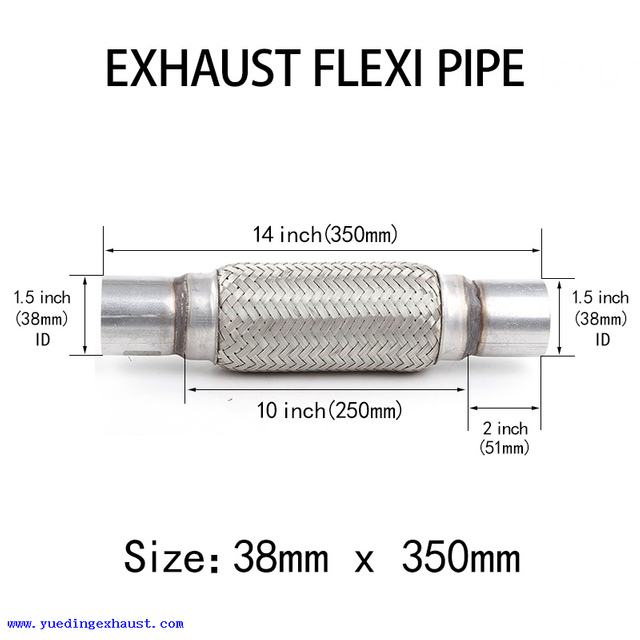
Overall length, flexible section length, inlet or outlet diameter, nipple length, flange geometry, and installation method affect how individual parts are produced and assembled. A simple weld-in connector requires a different component set from a flexible exhaust coupling supplied with finished extensions or custom flanges. Confirming these details early helps prevent a common sourcing problem: approving the flexible section while overlooking how the complete part will fit into the exhaust assembly.
Exhaust Flex Pipe Manufacturing: From Straight Tube to Corrugated Bellows
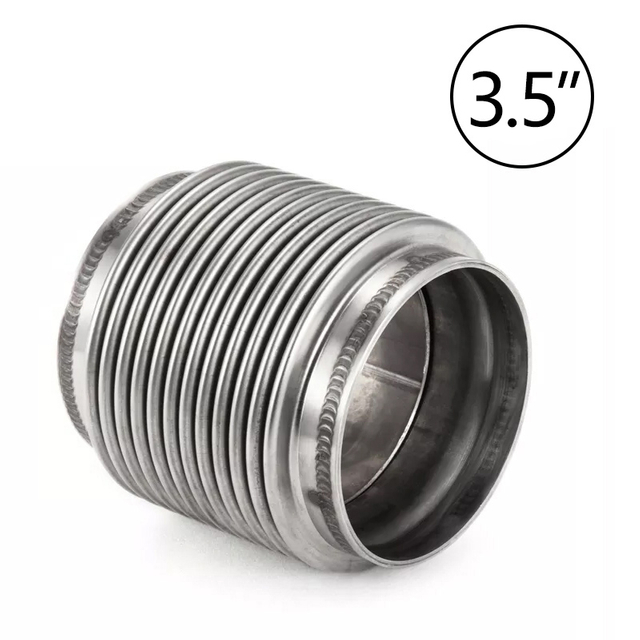
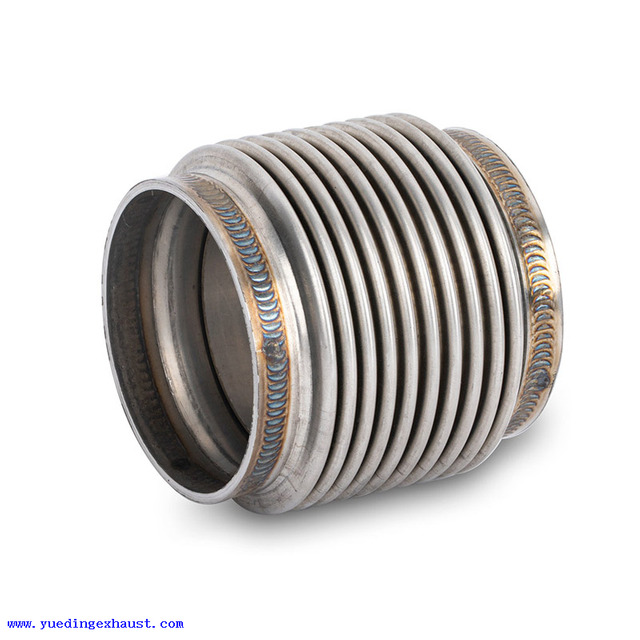
The bellows is the functional core of most flex-pipe constructions. It converts a relatively rigid metal tube into a section that can respond to controlled axial, lateral, and angular movement. Producing it consistently requires much more than simply pressing waves into a tube.
1. Tube preparation and dimensional setup
Tube material is prepared to the dimensions required for the forming operation. Length, diameter, wall condition, and material consistency matter because the tube must deform into repeated convolutions without producing unacceptable irregularities. Production planning also needs to account for the material required by later assembly steps rather than treating the bellows as an independent component.
2. Hydraulic corrugation forming
The straight tube is formed into a series of controlled corrugations. Yueding uses semi-automatic hydraulic forming equipment for metal bellows and flexible pipe production. During this stage, corrugation height, pitch, profile, and the usable flexible length have to remain consistent with the design.
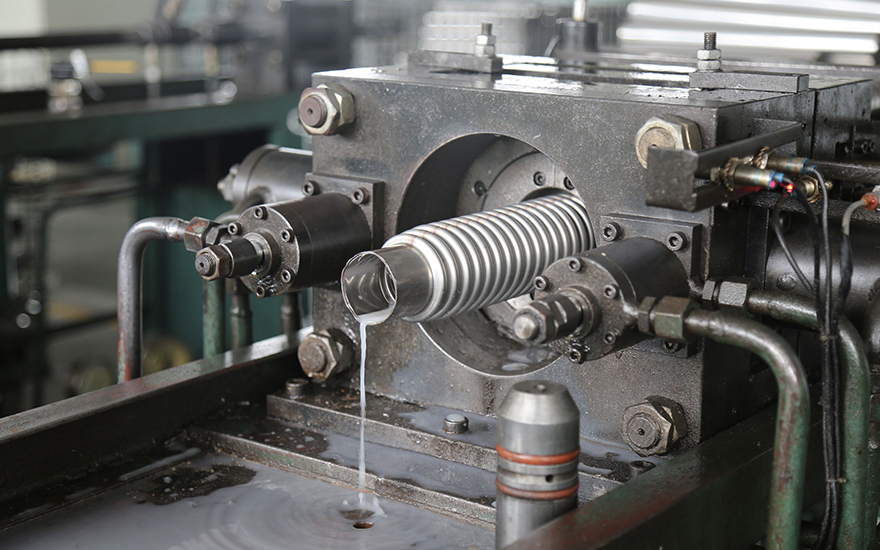
Corrugation dimensions cannot be considered separately. Deeper or differently spaced convolutions change the way the flexible exhaust tube moves, while wall thickness and material properties influence stiffness and forming behavior. Increasing apparent flexibility without considering fatigue stability or application loads can therefore create the wrong engineering trade-off.
3. Bellows geometry is checked before downstream assembly
Once formed, the corrugated section should match the required diameter, length, and shape before other components are added. Catching dimensional variation at this stage is more efficient than discovering it after braid, caps, and end tubes have already been assembled. This stage is especially important in repeat orders, where a visually similar part still needs to match an approved sample or drawing from batch to batch.
How Braid, Liners, Caps and End Connections Are Added
The corrugated bellows provides flexibility, but many exhaust flex pipe designs add other layers to change protection, flow characteristics, stiffness, or connection geometry. This is why terms such as exhaust flex tubing, exhaust flex joint, and flexible exhaust coupling can describe products that look similar but are not necessarily built the same way.
Inner braid, interlock, or no internal liner
An inner braid creates an additional flexible metallic layer inside the bellows. An interlock liner instead uses formed metal strip arranged into a continuous overlapping structure. These constructions can protect the corrugated section from direct gas flow and change the internal surface presented to the exhaust stream.
Not every application requires an internal liner. The correct choice depends on factors such as vibration, gas flow, installation location, available space, and required flexibility. Adding more structure is not automatically better because each layer can alter flexibility, weight, manufacturing cost, and assembly complexity.
External stainless steel braid or mesh
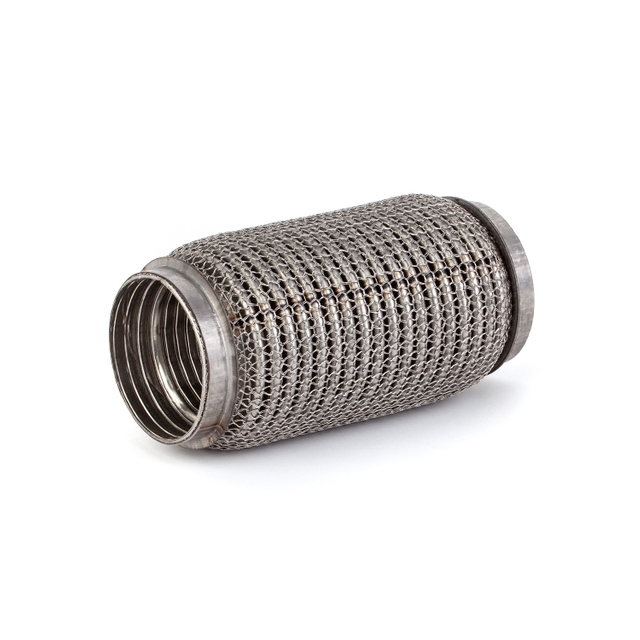
Stainless wire is woven on braiding equipment to create the outer layer used around the bellows. Braid density and construction can vary according to the product design. Yueding also produces a thin mesh flex pipe that uses a lighter mesh structure for applications where greater movement and lower braid-to-bellows friction are priorities.
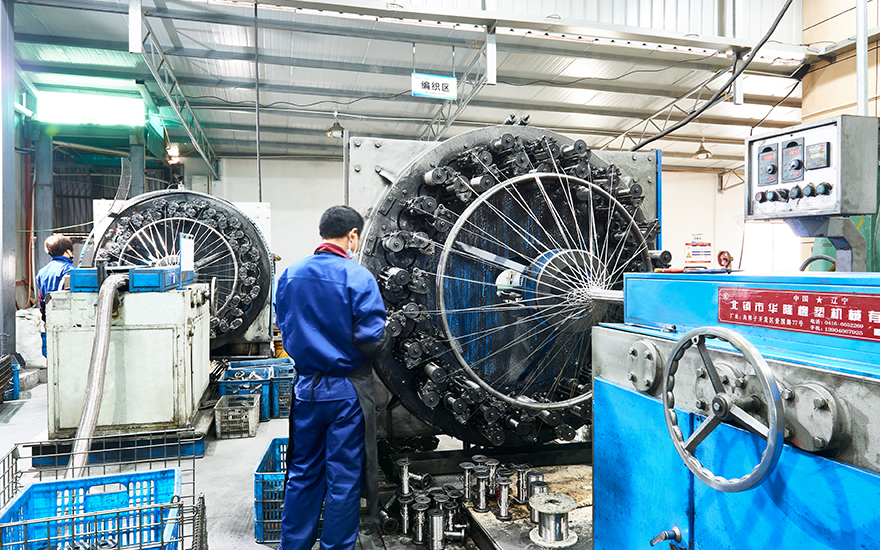
Other working conditions call for a more substantial construction. A heavy-duty braided flex pipe, for example, can incorporate stronger braid arrangements and customized flange connections for trucks, generators, machinery, and other demanding exhaust applications. The important manufacturing decision is matching the braid and connection architecture to the load rather than selecting a design by appearance alone.
Caps, nipples, extensions and flanges
Caps help retain the outer braid and create a controlled transition around the end of the bellows. Depending on the final product, nipples, extension tubes, collars, or flanges are then prepared for assembly. These components determine how the flex exhaust tubing interfaces with the rest of the system, so their concentricity and dimensions matter just as much as the flexible section itself.
Welding and Assembly: Where Separate Components Become One Flex Joint
After the bellows, braid, liner, caps, and end parts have been prepared, the components are assembled in the correct sequence and secured by the specified welding process. Yueding's manufacturing operations include laser welding as well as TIG welding for relevant metal connection components.
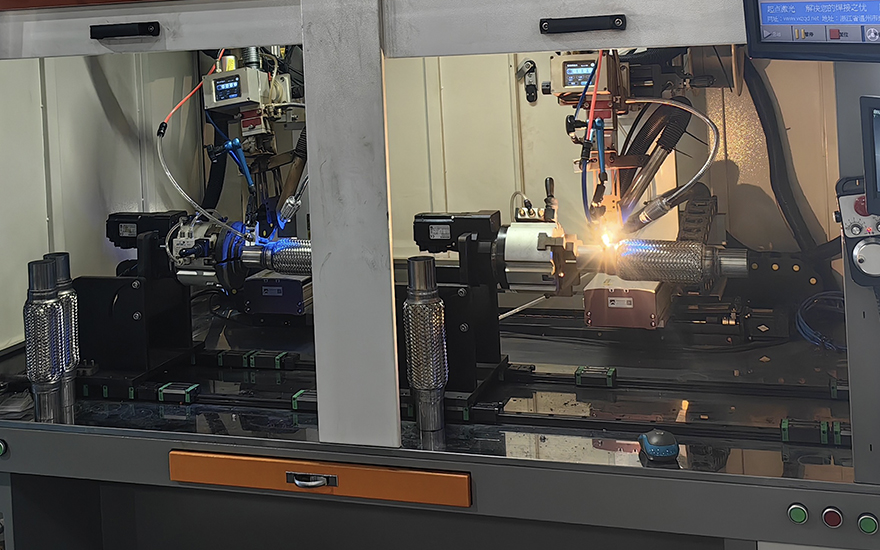
Welding quality is critical, but a visually smooth weld is not the only consideration. Heat input and assembly positioning can affect overall length, alignment, local distortion, and how accurately an end fitting matches the connecting exhaust pipe. Fixtures, repeatable positioning, and post-weld dimensional inspection are therefore important parts of controlled exhaust flex pipe manufacturing.
Diameter control becomes especially visible in standardized replacement sizes. A 2.5-inch stainless flex pipe, for example, is specified with a 63.5 mm inner diameter. The connection ends still have to remain compatible after corrugation forming, braid assembly, and welding rather than merely starting with the correct nominal tube size.
Finished assemblies may be designed for weld-on or clamp-on connection, and some incorporate pre-welded collars or flanges. The manufacturing drawing should make this connection method clear because the usable end length and dimensional tolerance can affect downstream installation.
Quality Control in Exhaust Flex Pipe Manufacturing
Quality control is most effective when it follows the production sequence instead of relying only on final inspection. Yueding's in-house processes include material review, dimensional checks, forming and welding control, as well as testing capabilities for bellows flexibility, pressure resistance, fatigue behavior, sealing, and corrosion-related requirements.
The appropriate test plan should still match the product and purchasing specification. Not every standard replacement flexible exhaust tube requires the same validation program as a custom industrial assembly. Buyers should define which inspections, records, samples, or test requirements apply before mass production begins.
Control Point | What Should Be Checked | Risk if Overlooked |
|---|---|---|
Incoming stainless material | Grade, thickness, dimensions, batch consistency | Unexpected forming or corrosion performance |
Corrugated bellows | Diameter, pitch, convolution profile, flexible length | Incorrect stiffness or inconsistent movement |
Inner liner | Correct structure, fit, continuity | Interference, poor assembly, unsuitable flow path |
Outer braid | Coverage, positioning, end retention | Uneven protection or premature mechanical damage |
Welded joints | Position, continuity, alignment, integrity | Leakage, distortion, weak connection |
Finished dimensions | Diameter, overall length, end dimensions, flange position | Installation mismatch |
Application-specific validation | Sealing, pressure, fatigue, flexibility or corrosion tests as required | Product approved without verifying critical operating requirements |
This process-based approach matters for bulk orders. A single correct sample does not by itself prove that material inputs, corrugation geometry, braid assembly, and welding will remain consistent over repeated production. Stable exhaust flex pipe manufacturing depends on controlling the variables that create the finished part, not only inspecting its appearance.
What Buyers Should Specify Before Exhaust Flex Pipe Production
Manufacturing becomes more predictable when the quotation and production specification describe the complete component. The broader exhaust flexible pipe range includes standard braid, inner braid, interlock, mesh, nipple, flange, and other configurations, so a diameter and length alone may not uniquely identify the required product.
Specification Item | What to Confirm | Why It Matters to Manufacturing |
|---|---|---|
Application | Passenger vehicle, truck, generator, machinery, repair, or custom assembly | Provides context for structure and validation |
Material | Required stainless grade for each relevant component | Affects forming, corrosion resistance, and cost |
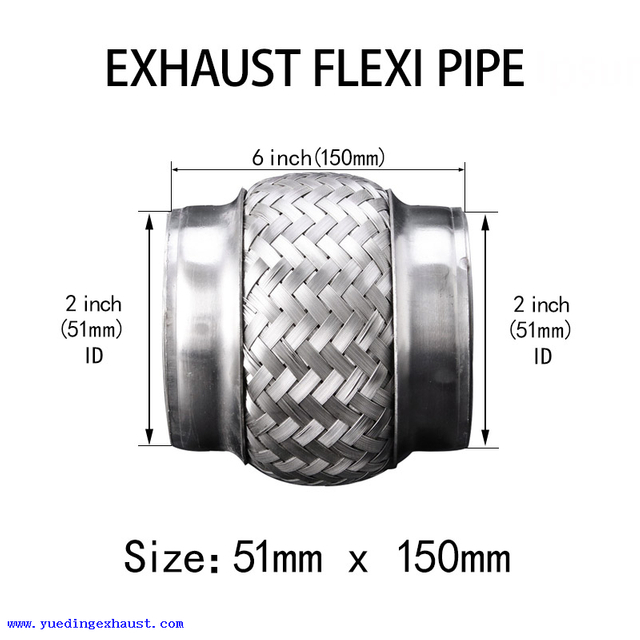
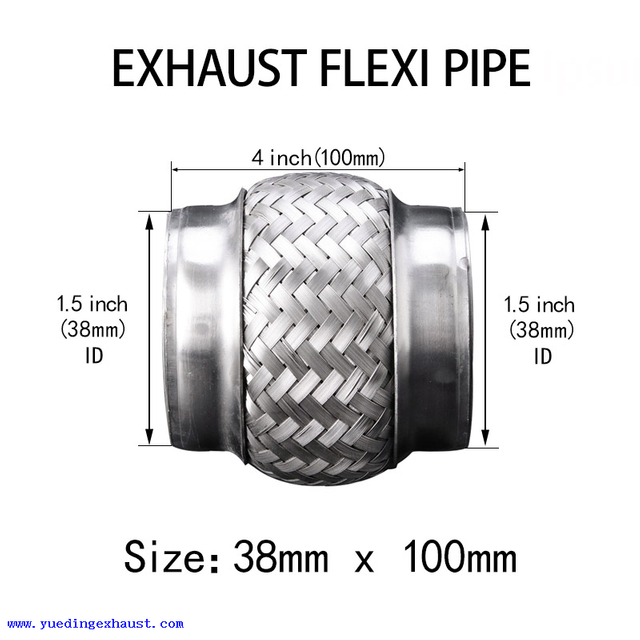
Diameter | Specify whether dimensions refer to ID or OD | Prevents connection mismatch |
Lengths | Overall length and flexible section length | Controls fitment and usable movement |
Construction | Outer braid, thin mesh, inner braid, interlock, or other required layers | Defines production sequence and component set |
End connection | Bare ends, nipples, extensions, collars, or flanges | Determines cutting, machining, assembly, and welding work |
Reference information | Drawing, approved sample, OE reference, or installation dimensions | Reduces ambiguity before tooling and production |
Inspection requirements | Dimensions, sealing, test reports, sampling level, or other agreed criteria | Establishes the acceptance method before production |
One frequent purchasing mistake is to treat all flexible exhaust tubing of the same nominal diameter as interchangeable. A 2.5-inch product with an interlock liner, for instance, does not have the same internal construction as a simple outer-braid connector. Overall length can also hide different flexible-section lengths. These details affect movement, installation, manufacturing cost, and the components required on the production line.
Another mistake is specifying a stainless grade while leaving connection geometry undefined. If a drawing includes flanges, nipples, or special extensions, their dimensions and orientation should be controlled alongside the bellows. For custom work, supplying a drawing or physical sample can remove assumptions that a product name alone cannot resolve.
Conclusion
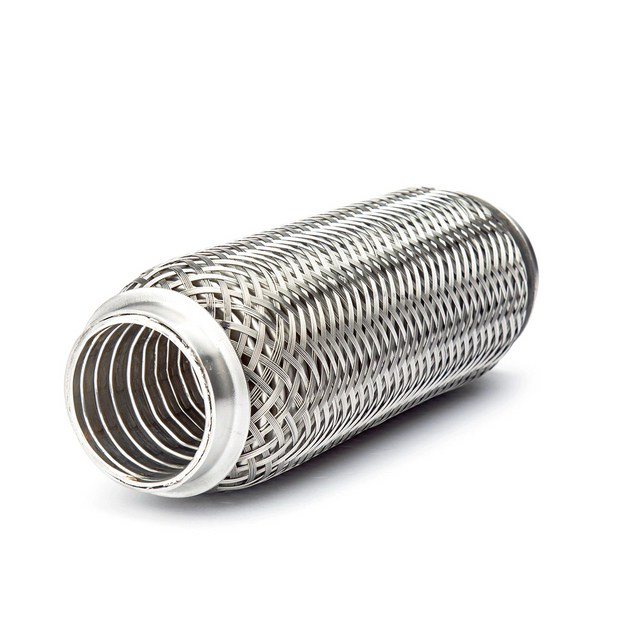
Effective exhaust flex pipe manufacturing is a coordinated process rather than a single corrugation or welding operation. Material preparation, bellows geometry, braid or liner design, end connections, welding, dimensional control, and application-specific inspection all contribute to the final flexible joint. Buyers can reduce specification errors by defining the complete construction and installation interface before production instead of relying only on nominal diameter or appearance. Zhejiang Yueding Corrugated Tube Co., Ltd. is a manufacturer with in-house forming, braiding, welding, assembly, inspection, and related exhaust flexible connection production capabilities.
FAQ
What materials are commonly used in exhaust flex pipe manufacturing?
Stainless steel is commonly used for the bellows, braid, liners, and many end components because exhaust systems involve heat, moisture, vibration, and corrosive exposure. Yueding's exhaust flex pipe range includes options in stainless steel 201, 304, 409, and 316. The appropriate grade should be evaluated together with wall thickness, structure, operating conditions, and cost rather than selected by grade name alone.
How does stainless steel flexible exhaust tubing become flexible?
The primary tube is formed into repeated corrugations that allow controlled movement instead of behaving like rigid tubing. Braid, mesh, or an internal liner may then be added depending on the required construction. Flexibility therefore comes mainly from the formed bellows geometry, while the surrounding layers modify protection and overall mechanical behavior.
Does every exhaust flex joint need an interlock liner?
No. Exhaust flex joints can be manufactured with an interlock liner, an inner braid, or without an internal liner. The choice depends on the intended application, vibration, flow requirements, installation space, required flexibility, and desired construction. Adding an interlock where it is unnecessary can change stiffness, cost, and manufacturing complexity.
Are an exhaust flex joint and a flexible exhaust coupling the same thing?
The terms are often used for closely related flexible exhaust connections, but the actual construction should be checked rather than relying on terminology. One flexible exhaust coupling may be a basic braided bellows, while another may include an interlock liner, extension tubes, collars, or flanges. A drawing and dimensions provide a clearer manufacturing definition than the product name alone.
What details matter most when ordering flex exhaust tubing for production?
Confirm the actual diameter, overall length, flexible-section length, stainless material, braid or liner structure, end connections, installation method, quantity, and required inspection criteria. For customized flexible exhaust tube production, drawings, samples, or detailed dimensions are particularly useful because visually similar products can have substantially different internal constructions and connection geometries.






About Yueding
YUEDING manufactures stainless steel exhaust flexible connectors, clamps, metal bellows, and selected automotive exhaust components under ISO and IATF quality systems. With in-house production, inspection, and packaging capabilities, we support bulk orders, standard-size inventory, and customized branding for global B2B customers.
Reliable Delivery
Stable production planning, standard-size inventory, and batch shipping support help make delivery more predictable.

Factory Direct
Production, inspection, and packaging are managed in-house, making communication, quality control, and customization more efficient.

Integrated Supply
We supply flex pipes, clamps, metal bellows, and selected exhaust components to support related purchasing needs from one manufacturer.

