
What Material Is Flex Pipe Made of?
A typical automotive exhaust flex pipe is primarily made from stainless steel, but that answer does not tell the whole story. A complete flex joint can contain a corrugated bellows, outer braid, inner braid or interlock liner, collars, nipples, and other end connections. Those components do not necessarily use the same steel grade. For buyers comparing flex pipe material, the useful question is therefore not simply “Is it stainless?” but “Which material is used in each working part?” Understanding that distinction makes it easier to compare a stainless steel exhaust flex pipe accurately instead of judging products by appearance or a single material label.
Quick Answer: Stainless steel is the dominant material for the flexible working section of an exhaust flex pipe because it combines corrosion resistance, formability, weldability, and resistance to exhaust-system temperatures. Common grades include 201, 304, 316, 321, and 409, depending on component design and operating requirements. Yueding offers multiple stainless grades across its Exhaust Flex Pipe Range, including 201, 304, 409, and 316, while other flex-pipe production options include 321.
What Is an Exhaust Flex Pipe Made Of?
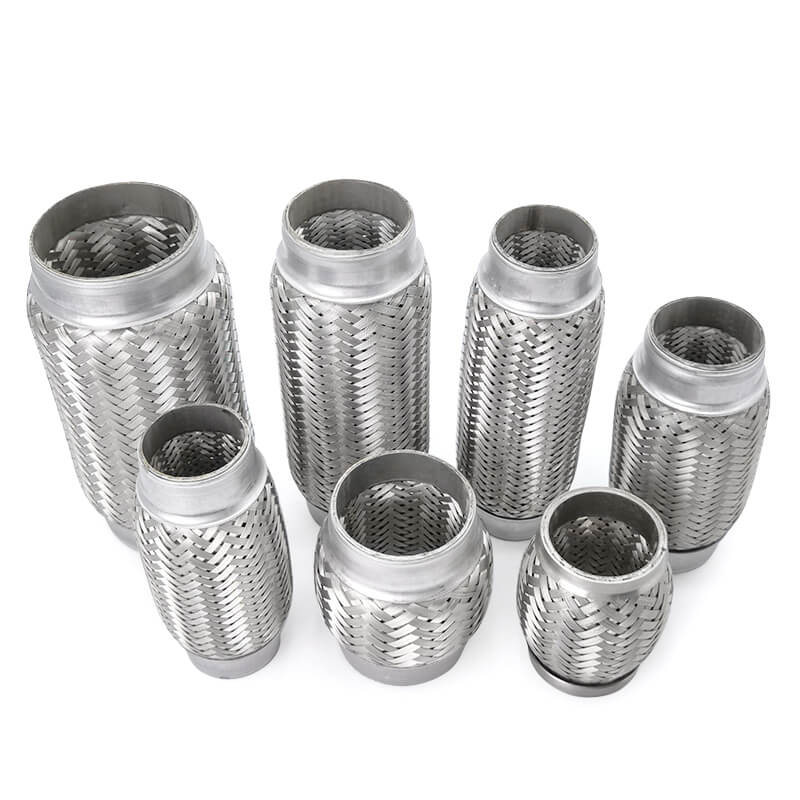
A flex pipe is better understood as a metal assembly than as one piece of flexible tubing. The visible woven surface is only one layer. Underneath it is normally a formed metal bellows that actually provides much of the movement required to absorb vibration and thermal expansion. Some designs add an inner braid or interlock liner, while the ends may incorporate collars, straight extensions, nipples, or flanges.
Corrugated bellows: the flexible core
The corrugated bellows is one of the most important parts to specify because repeated bending and thermal cycling are concentrated in this thin formed section. Stainless steel is well suited to this role because it can be formed into corrugations while retaining corrosion and oxidation resistance. A stainless flexible exhaust pipe therefore relies on both the alloy and the bellows geometry; simply choosing a higher alloy grade cannot compensate for an unsuitable wall structure or poor installation alignment.
Outer braid: reinforcement, not the source of flexibility
The woven outer layer on a stainless steel flex pipe reinforces and protects the corrugated section. It helps control excessive movement and shields the bellows from mechanical contact. The braid may be relatively dense on a heavy-duty design or lighter on a thin-mesh design. “Braided,” “double braided,” and “mesh braided” describe construction, however, not a stainless steel grade. Two products can both be called braided metal flex pipe while using different alloys underneath.
Inner liners and end connections
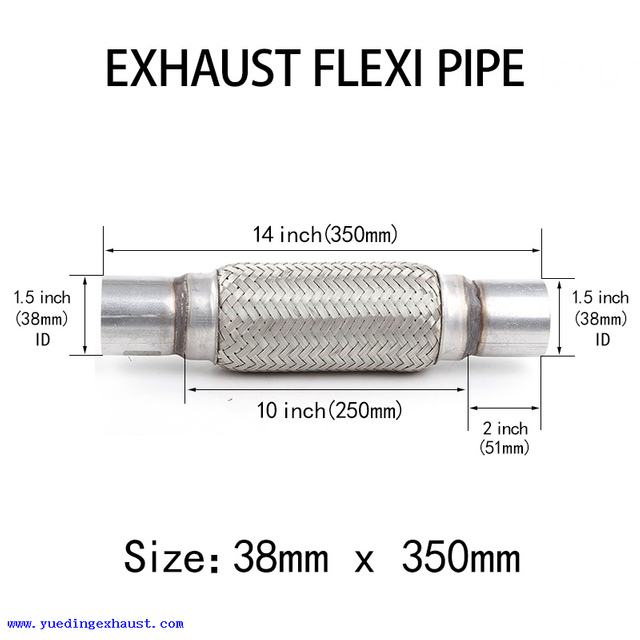
An inner braid can add another flexible layer, while an interlock liner uses a spirally formed metal structure inside the bellows. End components may include collars, tubes, nipples, or flanges depending on how the assembly will be installed. Yueding's Flex Pipe With Nipple, for example, is available with 304, 316, and 201 material options, while alternative nipple configurations can include carbon steel. This illustrates why the material description of the complete assembly should identify the component being specified.
Which Stainless Steel Grades Are Used for Flex Pipe Material?
There is no single stainless alloy that defines every stainless steel flexible exhaust pipe. Automotive exhaust applications use both austenitic and ferritic stainless grades, and the appropriate choice changes with corrosion exposure, temperature, forming requirements, welding, component position, and purchasing cost. Stainless steels including 304, 316, and 409 are established in automotive applications, while 409 is particularly associated with exhaust systems.
Stainless Grade | Key Material Characteristic | How to Treat It in a Flex Pipe Specification |
|---|---|---|
201 | Cost-conscious austenitic stainless option used in selected flex-pipe constructions | Confirm which components use 201 and whether the operating environment matches the material requirement |
304 | General-purpose austenitic stainless with good corrosion resistance, formability, and weldability | A practical reference grade for bellows, braid, and other stainless components where balanced properties are required |
316 | Molybdenum-alloyed austenitic stainless with increased corrosion resistance | Consider where the environment creates a higher corrosion requirement than a standard general-purpose grade |
321 | Titanium-stabilized austenitic stainless suitable for an extended temperature range | Evaluate for applications where temperature exposure and the specific component design justify a stabilized grade |
409 | Ferritic stainless widely associated with automotive and industrial exhaust applications | Useful for exhaust-related parts, but corrosion expectations should be matched to the actual environment |
Grade 304 is often the easiest reference point when comparing a stainless steel exhaust flex pipe because it combines general corrosion resistance with good fabrication characteristics. Grade 316 contains molybdenum and is intended for environments with greater corrosion demands. Grade 409 provides a different balance: it is a ferritic stainless designed for applications including automotive and industrial exhaust systems, but it has more limited corrosion resistance in increasingly aggressive environments.
Grade 321 should not be interpreted simply as “better 304.” It is titanium stabilized and offers improved resistance to intergranular corrosion across an extended temperature range. Material selection should therefore follow the actual temperature history, fabrication method, exposure, and component role rather than a numerical ranking of stainless grades.
For available material and structural combinations, Yueding's Stainless Flex Pipe Options include stainless grades such as AISI 304, 316, 321, and 409 for different exhaust requirements.
Stainless Steel vs Steel: Does the Whole Flex Pipe Use One Material?
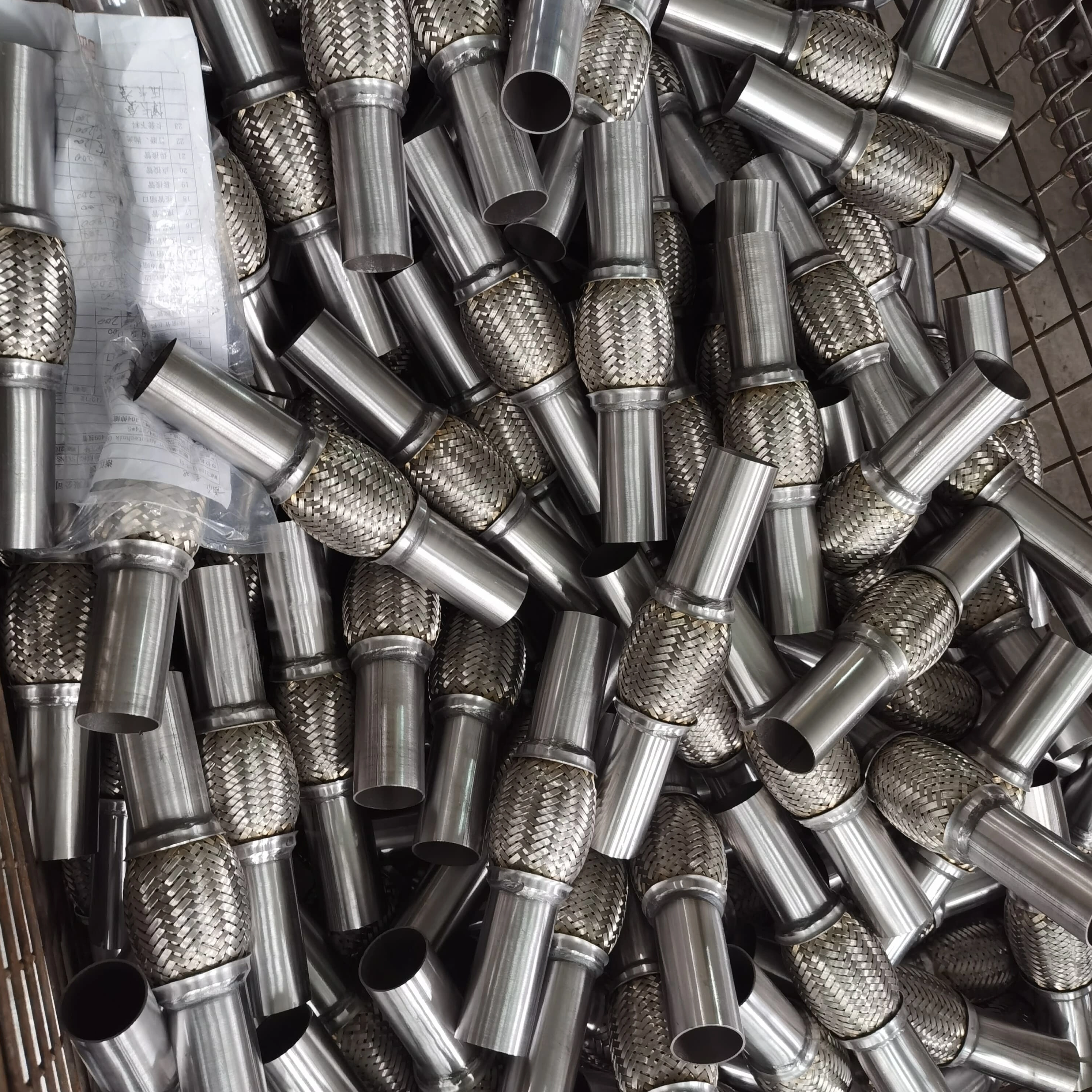
The terms steel flex pipe, stainless flex pipe, and metal flex pipe are often used loosely. For purchasing, these descriptions are not precise enough. A product can have a stainless steel bellows and braid while using a different grade or material for its collars, nipples, or other rigid end sections.
This mixed-material approach is not automatically a weakness. Each component performs a different job. The bellows needs repeated flexibility. The braid needs to reinforce and protect that bellows. A nipple or extension needs suitable weldability and dimensional stability at the joint. The correct question is whether the material assigned to each component is appropriate for its operating environment and compatible with the intended fabrication process.
This is especially important when an RFQ says only “304 stainless steel flex pipe.” Does 304 refer to the corrugated bellows, the outer braid, the liner, the collars, the nipples, or every metal component? Without that clarification, two suppliers can quote products that sound identical but have different material compositions.
The same principle applies to the phrase stainless steel flex exhaust tubing. A stainless exterior does not, by itself, establish the material of the internal liner or welded extensions. Component-level specification is more useful than relying on color, surface finish, or a broad “all metal” description.
How to Specify Flex Pipe Material Before Ordering
A useful exhaust flex-pipe specification separates material, structure, and dimensions. Mixing those categories creates avoidable ambiguity. “304 double braid, 2.5 inch” is better than “stainless flex pipe,” but a repeatable bulk specification should go further by defining where the 304 applies and by confirming the actual mating dimensions.
Item to Confirm | Question to Ask | Why It Matters |
|---|---|---|
Bellows material | What exact stainless grade is used for the corrugated tube? | The bellows carries repeated flexing and thermal movement. |
Outer braid | What grade and braid structure are used? | Braid construction affects reinforcement and external protection. |
Inner layer | Is the design inner braid, interlock, or open bellows? | The internal structure changes protection, movement, and internal geometry. |
Collars and ends | Do the end components use the same alloy as the bellows? | A single material label may not describe the complete assembly. |
Diameter | Does the quoted size refer to ID, OD, or mating pipe size? | Correct material cannot compensate for a dimensional mismatch. |
Length | Are overall length and flexible-section length both defined? | Installation geometry affects how the flex section is loaded. |
Environment | What temperature, moisture, road salt, or corrosive exposure is expected? | Material selection should reflect the real operating condition. |
Connection method | Will the assembly be welded, clamped, flanged, or supplied with nipples? | End material and geometry must suit the assembly method. |
One common purchasing mistake is specifying the most expensive grade without defining the actual operating problem. Another is treating double braid as a material grade. A third is focusing only on alloy while ignoring diameter, flexible length, liner type, and installation alignment. Material is one part of flex-pipe durability; it cannot correct an assembly that is installed under excessive tension, compression, or misalignment.
For repeat orders, material verification should also be discussed before production where the application requires it. Yueding supports raw-material checks for chemical composition as well as finished-product inspection options covering dimensions, weld appearance, braid condition, vibration or torsion resistance, corrosion resistance, and assembly matching according to order requirements.
A clear purchase description might therefore identify the bellows grade, braid type, liner structure, end material, inlet or outlet dimensions, overall length, flexible length, and connection method. That specification gives a much more meaningful basis for comparing a stainless steel flex pipe than the phrase “high-grade stainless” alone.
Conclusion
The most common answer to “what material is flex pipe made of?” is stainless steel, but professional selection requires more detail. The bellows, braid, liner, collars, and end pipes can perform different functions and may use different grades. Evaluate flex pipe material together with structure, dimensions, environment, and connection method rather than choosing by alloy name alone. Zhejiang Yueding Corrugated Tube Co., Ltd. is a manufacturer and supplier of exhaust flexible connection products with in-house processes covering tube preparation, bellows forming, braiding, welding, and related production operations.
FAQ
What is the most common flex pipe material?
Stainless steel is commonly used for automotive exhaust flex pipes because it combines corrosion and oxidation resistance with the formability needed for corrugated and braided components. Automotive exhaust applications use multiple stainless grades rather than one universal alloy.
Is a stainless steel flex pipe better than a regular steel flex pipe?
It depends on what “regular steel” means and on the application. Stainless steel generally provides greater corrosion resistance than carbon steel, but the final choice must also consider temperature, component position, welding, cost, dimensions, and structural design. A higher-grade alloy does not correct poor fitment or excessive mechanical loading.
Is 304 or 409 stainless steel better for an exhaust flex pipe?
Neither grade is automatically better for every component. 304 is an austenitic stainless with good general corrosion resistance, formability, and weldability. 409 is a ferritic stainless widely used in automotive exhaust applications and offers a different balance of oxidation resistance, corrosion performance, and cost.
Does double braided mean the flex pipe is 304 stainless steel?
No. “Double braided” describes construction, not alloy grade. The bellows, inner braid, outer braid, and end components should be identified separately if a specific stainless grade is required. A double-braided stainless steel exhaust flex pipe can therefore have a different material specification from another product with a similar appearance.
Can one exhaust flex pipe contain different metal materials?
Yes. A complete assembly can use one stainless grade for the flexible bellows and different materials or grades for braid, liners, collars, nipples, flanges, or straight extensions. Yueding's nipple-type flex pipe, for example, offers several stainless material options and alternative nipple material configurations.




About Yueding
YUEDING manufactures stainless steel exhaust flexible connectors, clamps, metal bellows, and selected automotive exhaust components under ISO and IATF quality systems. With in-house production, inspection, and packaging capabilities, we support bulk orders, standard-size inventory, and customized branding for global B2B customers.
Reliable Delivery
Stable production planning, standard-size inventory, and batch shipping support help make delivery more predictable.

Factory Direct
Production, inspection, and packaging are managed in-house, making communication, quality control, and customization more efficient.

Integrated Supply
We supply flex pipes, clamps, metal bellows, and selected exhaust components to support related purchasing needs from one manufacturer.

