Two pipes coming in and one going out? Start with a merge Y-pipe. If one pipe feeds two rear branches, look for a split Y-pipe. If two pipes run through the whole section, compare an X-pipe and an H-pipe. An H uses a short bridge between the existing runs. An X needs room for the two runs to come together and spread apart again.
Count the pipes where you plan to fit the part. Two tips at the bumper can be fed by a single pipe farther forward. The decision below is based on the layout at the joint you’re working on.
X-Pipe vs. Y-Pipe: Which Layout Are You Building?
Trace the exhaust from front to back at the point you plan to change. Count the pipes on each side of that point. Then decide whether the new section should keep two routes or merge them into one.
X-pipe
Two in, two out. The runs meet at an open center junction and separate again.
H-pipe
Two in, two out. A short bridge connects the two main runs.
Y-pipe
Two into one or one into two. Choose a merge or a split built for the intended flow direction.
The sketches run from the front of the vehicle on the left to the rear on the right. The Y sketch shows a merge. For a rear split, the single pipe feeds the two branches. A system can use both layouts at different points, so take measurements at the fitting you are replacing.
| Your job | Start with | Check before buying |
|---|---|---|
| Two front pipes feed the single mid-pipe you’re keeping. | Merge Y-pipe | Measure both front pipe ends and the single mid-pipe end. Check where the single outlet needs to land. |
| One mid-pipe needs to feed two rear branches. | Split Y-pipe | Check the single inlet joint and make sure both branches can reach their intended routes. |
| Two parallel runs are already in place and you want a crossover with minimal rerouting. | H-pipe | Check the space across the gap for the bridge, including any crossmember or brace in its path. |
| Two runs will stay and you have space to bring them together through a crossover. | X-pipe | Compare the four end positions and the length needed to converge and separate the runs. |
How an Exhaust X-Pipe Connects a Dual Exhaust
An exhaust X-pipe brings two pipes together at the center and gives their exhaust pulses a shared junction. Two outlets carry the flow onward. That makes an X useful in a dual layout where the shop has room to bring the runs together and then route them back out.
Check the approach on both sides
Look at the pipes before and after the crossover. They can sit at different heights or spread farther apart toward the rear. A fitting with the right tube diameter can still require extra bends if its ends sit too close together or point away from the existing runs.
Yueding’s stainless steel X-pipe connector is offered in 304 or 409 stainless steel. Give the supplier the end diameters, center spacing, and inlet and outlet angles to check the fit for your layout.
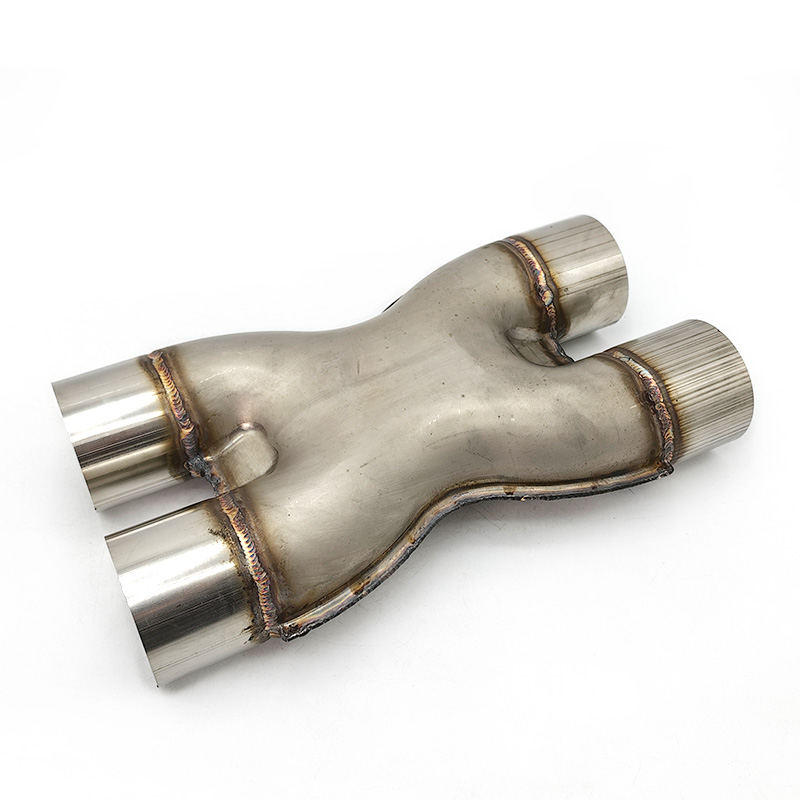
If you’re replacing a section between two existing pipes, mark where the new joints can sit before picking a crossover. A transmission crossmember can leave room for the X body while blocking access to a clamp at one of its ends. Look at the entire section you’ll install, including any adapters and the space needed to tighten or weld each joint.
The center junction can change how pressure pulses travel through the system. The effect depends on the engine and the rest of the exhaust, including the mufflers and where the crossover sits. Judge a sound or power claim against the setup it was measured on.
When to Use an Exhaust Y-Pipe
An exhaust Y-pipe makes a transition between one run and two. Take a look at the existing layout before choosing the fitting. The same general shape can serve very different jobs, and the end sizes, angles, and joints depend on the direction of the transition.
Merge two pipes into one
Use a merge where two front pipes feed a single downstream run. Check both branch angles and the position of the single outlet. One branch can need a different approach angle if the two front pipes sit at different heights or distances from the center of the vehicle.
Split one pipe into two
Use a split where one upstream run feeds two rear branches. Start with the position of the single inlet, then check how each branch will reach its muffler, hanger, or tailpipe. A centered inlet can still lead to offset branches under the car.
For a replacement, label each end on a sketch and add an arrow showing flow. Include the joining method. A slip-fit fitting may have an expanded end on one side, and a flanged fitting may only meet the existing hardware in one orientation. Confirm the intended direction for the part before assuming it can serve as both a merge and a split.
Specify the transition by its ends
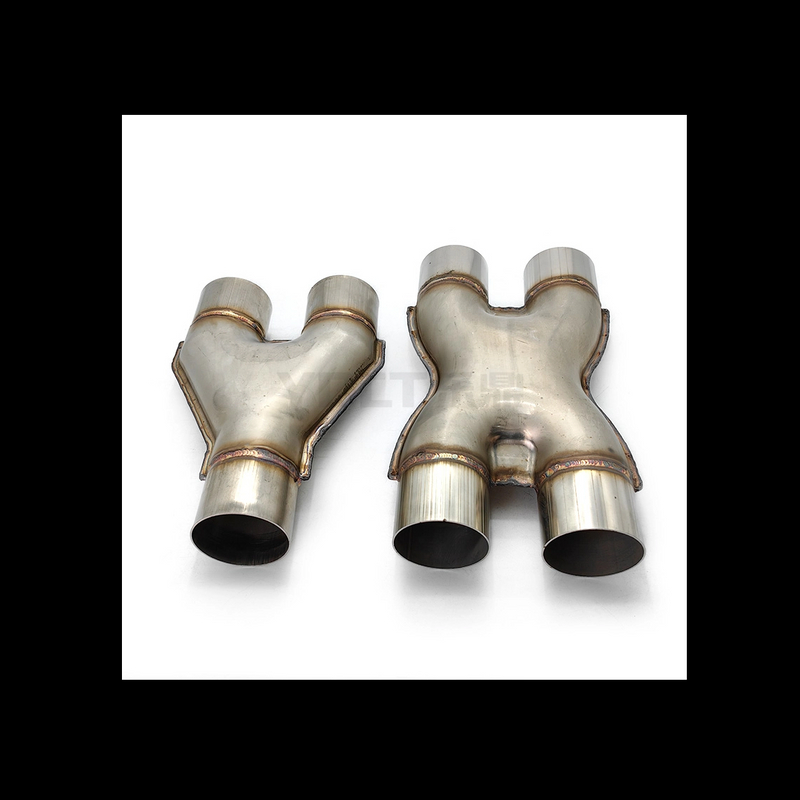
Yueding’s X-pipe and Y-pipe connectors are offered in 409 stainless steel or aluminized steel. For a Y configuration, show the diameter and direction at all three ends. If the branches differ in angle, mark each angle on the drawing so the fitting can be checked against the space under the vehicle.
The single leg deserves its own size check. If it meets a muffler or an existing pipe, confirm the connection there first. Pipe area can help explain why two branch diameters alone don’t tell you what the single leg needs to be. The rest of the system and the intended application matter to that choice.
How an H-Pipe Compares With an X-Pipe
An H-pipe uses a short cross tube between the two main runs. The main pipes can stay on their separate routes through the section. With an X-pipe, they angle toward a common junction and then apart again. If the pipes are already in place and run parallel, look for a spot where a bridge can fit. If you’re laying out a new section, compare the bends and end positions an X would need.
| What to check | H-pipe | X-pipe |
|---|---|---|
| Where the runs connect | A short bridge joins the sides. | The sides meet through the center junction. |
| Room for the fitting | Check the span across the gap and what sits in its path. | Check the length for both runs to converge and separate. |
| Changes to existing tubing | Check whether the existing routes can be kept. | Check the angle, height and spacing where the four ends will meet. |
How to compare the sound
On comparable dual systems, an H-pipe can give the exhaust a deeper tone, while an X-pipe can sound higher pitched. Listen to clips with the same engine, mufflers, resonators, and pipe size if you can. A recording at idle tells you little about cabin noise at highway speed, so compare the same driving condition as well. The crossover is one part of the sound you hear.
If you’re changing the mufflers and crossover together, it’s hard to tell how much of the sound change came from either part. Compare the complete setup you intend to run. If the goal is to address cabin drone at a particular speed, include a recording or test drive at that speed in the comparison.
Mid-Pipe Fitment Checklist
Mark the ends of the section you’re replacing on a sketch. Use the existing joints as reference points if they will stay in place. That gives you and the fabricator a shared view of where the new part must begin and end.
| Measure or record | What to send | Why it matters |
|---|---|---|
| Diameter and joint type | Outside diameter (OD) at each tube end. Include inside diameter (ID) and engagement depth for a slip joint. | A slip joint fits one end inside the other. A butt joint brings two ends together. |
| Pipe spacing and height | Center-to-center spacing across the pair at the front and rear. Note any height difference. | The fitting has to meet both runs in the same position. |
| Length and direction | Distance between the planned joints, plus end angles and the direction of flow. | Bends, transitions and clamps all take up some of the space. |
| Clearance and access | Location of the crossmember, heat shields, hangers and any nearby components. Show room for tools at each joint. | A part can fit between the pipes and still be difficult to mount or service. |
Here’s a common measurement trap. Suppose two equal pipes each measure 2.5 inches OD and the gap between their nearest outer surfaces is 1 inch. If they are side by side at the same height, the center-to-center spacing is 3.5 inches. Put that number on the sketch and label it clearly. The gap and the center spacing describe different dimensions.
What that measurement changes
Say the two pipes in the example are the ones you want to keep. An X-pipe with matching 2.5-inch weld ends still needs to meet the existing runs 3.5 inches apart at that joint. Compare that measurement with the connector drawing and repeat the check at the other pair of ends. If the positions differ, plan for transition bends and check how much length they use. For a short section with parallel runs, an H bridge may be the easier crossover to fit if there is a clear path between the pipes.
On a one-off build, ask for an outline drawing of the fitting so you can compare its widest and lowest points with the space available. For a repeat order, keep the approved drawing with the part number and record which dimensions are critical at the mating ends. That is especially useful if two connectors share a nominal diameter but have different branch angles. A shop can then check incoming parts against the same dimensions it used to plan the installation.
For a welded fitting, ask which dimensions the fabricator needs at the planned cuts. For a clamp connection, check the joint style, the mating diameters and how much straight tubing the clamp requires. If the vehicle is used on the road, keep the existing emissions equipment and sensor locations in the layout review.
What to send with a fitment inquiry
Label each end on a sketch and add an arrow for flow direction. At each end, record the mating diameter and whether the joint will be welded, clamped or flanged. Give the center spacing where there are two pipes and show the distance available between the planned joints. When ordering a Yueding connector, ask for the end positions and overall dimensions on the drawing so you can compare them with the space under your vehicle.
Frequently Asked Questions
How can I tell whether an X-pipe or Y-pipe is already on my car?
Look at the section where the pipes meet. An X has two ends on each side of the junction. A Y has three ends in total, with one on one side and two on the other.
Is a single pipe that splits into two tips a true dual exhaust?
At the split, it has two outlets fed by one upstream pipe. Follow the routing farther forward to see how the rest of the system is laid out.
Can I order a connector by its nominal pipe size alone?
Use the nominal size to narrow your options. Measure the mating ends and confirm whether the quoted dimension is OD or ID, especially where one pipe slides into another.
Will an X-pipe fit where an H-pipe was installed?
It depends on the room around the existing runs. Compare the length, the position of all four ends and the clearance where the pipes would converge. Check whether the replacement requires changes to the adjoining tubing.