
How to Measure Clamp Size: Hose & V-Band Fitment Guide
To size a hose clamp, first fit the hose to its corresponding fitting. Then, measure the outside diameter at the clamping position and compare it with the specified diameter range of the clamp. While the size on the hose packaging, the fitting diameter and the markings on an old clamp can help to identify the required components, they may not provide enough information to select a replacement clamp.
Once you have checked the diameter range, confirm the band width and available installation space. V-band connections require a different approach: the matching tube diameter helps to identify the nominal size, but the flange dimensions and profile must also match.
Which diameter should you measure for a hose clamp?
Hose clamp sizing starts with the outside diameter at the clamping position after the hose has been installed on the fitting. The inside diameter of the hose determines how it fits the fitting; it does not replace the outside diameter measurement needed to size the clamp.
A hose cross-section has three related dimensions: inside diameter, outside diameter and wall thickness. Two hoses with the same inside diameter may have different outside diameters if their wall thicknesses differ, meaning they may require different clamp sizes. Additionally, a hose can expand when pushed onto a fitting. Therefore, measuring an unassembled hose alone may give a different result to measuring the actual connection.
The measurement location matters too. First, confirm the specified hose insertion depth and the designated clamping area of the fitting, then measure the outside diameter at that location. Do not use the diameter over a retaining bead, thread or other projection outside the clamping area as the final working diameter. Whether the clamp can pass over these features is a separate installation check.
If the matching fitting is unavailable, record the unassembled outside diameter of the hose as a preliminary reference, clearly noting its condition during measurement. Measure the assembled connection before confirming.
How to Measure the Hose Diameter
Use callipers to measure the outside diameter directly if you can access both sides of the hose. If the calipers will not fit, but you can wrap a tape measure around the hose, measure the circumference and calculate the diameter. First, clean the surface, and only work after the system has been shut down, depressurised and allowed to cool.
Check the measuring area for visible damage, old clamp impressions or distortion. If the surface has changed shape, assess whether the connection is still suitable for use, rather than taking a measurement over the damaged area as the normal diameter.
Use calipers to measure the outside diameter.
Install the hose in its specified position. Ensure that the actual clamping area is accessible and that compression from an old clamp does not affect the reading.
Keep the callipers square to the hose. Measure perpendicular to the centreline of the hose rather than diagonally across it.
Touch the hose surface lightly. Close the jaws slowly until they touch both sides of the hose. If the hose is visibly compressed, the reading will not represent its uncompressed outside diameter.
Repeat the measurement from different directions. Record the readings. If they vary noticeably, check for an oval hose, incomplete insertion or local distortion, rather than simply selecting a clamp based on the smallest value.
Record the units and assembly condition. For example, “approximately 30 mm OD at the clamping area, with the hose installed on the fitting” is more useful than “30” alone.
The number of decimal places displayed on a calliper does not determine the accuracy of a hose measurement. Jaw pressure, tool alignment and surface distortion can all affect the result. If a reading is close to a clamp range limit, repeat the measurement and check the product selection requirements.
Calculate the diameter from the circumference.
Wrap a narrow, non-stretch tape measure around the clamping area. Keep it in contact with the surface and ensure it remains in a single cross-sectional plane. Make sure it does not run diagonally and do not pull it tight enough to compress the hose. Record the circumference and use this formula:
Diameter D = Circumference C ÷ π, using π ≈ 3.1416.
For example, a circumference of approximately 94.2 mm gives a diameter of approximately 30.0 mm. This calculation is for example purposes only and does not indicate whether a particular clamp model is suitable for the connection.
Standard tape measures circumference, which requires conversion. A dedicated diameter tape measure displays the diameter directly, so check its scale before using it. If the hose is noticeably out of round, the calculated diameter alone is insufficient to confirm the clamp's fit.
How to Match Your Measurement to a Clamp Size
Compare the outside diameter of the assembled hose with the specified diameter range for the exact clamp model. Then check the band width and installation space. Falling within the range is an initial sizing check only and does not confirm that the material, clamp design and operating conditions are all suitable.
Read the clamp’s diameter range.
A specification such as '16–27 mm' usually indicates the product's clamping diameter range rather than the inside diameter of the hose or the width of the band. When reading a size chart, check which series and model the range is associated with, and which units are used. Do not infer dimensions solely from the digits at the end of a model code.
For instance, Yueding’s German-type hose clamp specifications list a diameter range of 16–27 mm for both the 09B1627 and the 09Q1627 models. If an assembled connection measures 24 mm OD, these models pass the initial diameter-range check. However, material, band width and application requirements still need to be checked before selecting either model.
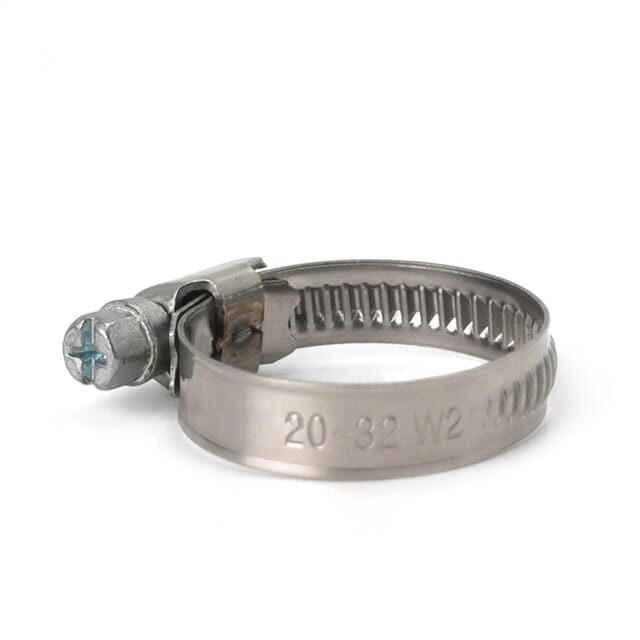
The entries below illustrate how to read the specifications. They are not a complete selection chart for ordering by diameter alone.
Yueding German-Type Hose Clamp Models | Diameter Range | What to Check |
|---|---|---|
09B1016 / 09Q1016 | 10–16 mm | Use the assembled hose OD, not the hose ID. |
09B1222 / 09Q1222 | 12–22 mm | Adjacent ranges may overlap; check the remaining selection requirements. |
09B1627 / 09Q1627 | 16–27 mm | Near a range limit, check dimensional variation and the product requirements. |
Just because one clamp is larger or smaller than another does not automatically make it the better fit. Check the assembly requirements and instructions for the specific model, as well as the actual variation in hose outside diameter. Do not apply the same fixed sizing allowance to all clamps; worm-drive, T-bolt, spring-band and ear clamps do not all use the same dimensions or installation methods.
For bulk orders, measure multiple samples rather than selecting a size for the whole batch from one sample alone. Even connections with the same nominal size can vary due to differences in the actual dimensions of the hose and fitting.
Check band width and available installation space.
The clamp band must fit the available clamping area on the fitting. Even if the diameter range is suitable, ensure that the band can sit fully in its designated position without interference from fitting shoulders, bends or nearby components.
Also check the clearance for the screw housing, and ensure that the tightening tool can reach and operate correctly. When reviewing a candidate, compare the dimensions and construction of Yueding’s German-type hose clamps rather than comparing diameter ranges alone.
A wider band does not automatically make a better choice. Available space, the hose surface and the clamp design must be considered together. Refer to the drawing and installation requirements for the exact model.
Situation | Next Step |
|---|---|
The measurement is outside the specified range. | Select a different size. Do not compensate by overtightening or stretching the clamp. |
The reading is near a range limit, or readings vary noticeably by direction. | Measure again, record the variation, and check the model’s requirements. |
Two sizes both cover the measurement. | Compare band width, installation space, and the requirements for each product. |
The diameter is suitable, but the housing or band interferes with nearby parts. | Recheck the design or size. Diameter coverage alone does not confirm fit. |
The specification gives one number without defining it. | Confirm whether it is a nominal size, working diameter, or model code. |
Measuring a V-band connection? Check the flanges too.
As a V-band clamp holds two matching flanges together, the methods used to measure hose clamps do not directly apply here. While the matching tube outer diameter (OD) helps to identify the nominal size, replacing an existing clamp also requires checking the flange OD, profile widths and locating features. Compatibility between two assemblies cannot be established by the same nominal tube size alone.
The checks required when buying a matched assembly differ from those needed to replace one component. For more information on connections, sizing and installation, please refer to our guide on how V-band clamps work.
Frequently Asked Questions
How can I measure a hose when calipers will not fit?
If you can wrap a narrow tape measure around the actual clamping cross-section, measure the circumference and calculate the diameter. If neither callipers nor a tape measure can reach it, do not take a reading from a nearby, more accessible location as a substitute. Measure after safe disassembly, or check a sample made from the corresponding hose and fitting, noting how it relates to the actual connection.
Can I use an old clamp to identify the replacement size?
The model, range and band width marked on an old clamp can provide useful identification details. However, a distorted, stretched or tightened clamp should not be used as the direct dimensional reference for a replacement. Measure the actual connection again if the hose or fitting has changed. If the markings are unclear, provide photos of the old clamp and details of the connection, along with the measured dimensions, for comparison.
When asking Yueding to confirm a size, please provide details of the connection type, the assembled hose outer diameter (OD) and the units, photos of the hose and fitting, the available clamping width and the operating conditions. Include any existing model numbers or drawings as well. These details will help us to match the measured connection to a specific product.






About Yueding
YUEDING manufactures stainless steel exhaust flexible connectors, clamps, metal bellows, and selected automotive exhaust components under ISO and IATF quality systems. With in-house production, inspection, and packaging capabilities, we support bulk orders, standard-size inventory, and customized branding for global B2B customers.
Reliable Delivery
Stable production planning, standard-size inventory, and batch shipping support help make delivery more predictable.

Factory Direct
Production, inspection, and packaging are managed in-house, making communication, quality control, and customization more efficient.

Integrated Supply
We supply flex pipes, clamps, metal bellows, and selected exhaust components to support related purchasing needs from one manufacturer.

