
Types of Exhaust Clamps: How To Choose The Right Clamp for Your Pipe Connection
Table of Contents
Exhaust clamps are used to connect, secure, and help seal exhaust pipes, mufflers, exhaust flex pipes, downpipes, tailpipes, and other exhaust tubing parts. They may look like small accessories, but if you need long-term supply, custom parts, or matched exhaust system components, the right clamp can affect installation feedback, connection stability, after-sales communication, and repeat orders.
The value of an exhaust clamp is not only about whether it can hold the pipe tightly. U-bolt clamps are suitable for basic repair and cost-sensitive replacement parts. Band clamps help reduce pipe deformation and provide a cleaner connection. Lap joint clamps and butt joint clamps are used for different pipe end structures. V-band clamps are suitable for flanged connections that need easy removal. DPF clamps and heavy-duty exhaust clamps are more suitable for trucks, diesel engines, and large-diameter exhaust systems.
If your product range includes exhaust flex pipes, exhaust pipes, mufflers, truck exhaust parts, or repair kits, clamps should not be treated as simple add-on parts. A suitable clamp can make the whole product easier to install, reduce the need for customers to find extra connection parts, and make your product easier to explain and repeat.
What Do Exhaust Clamps Do in an Exhaust System?
An exhaust system works under heat, vibration, thermal expansion, road impact, and corrosion. Exhaust clamps do more than hold two pipes together. They help keep the connection stable and reduce the risk of loosening, movement, noise, and exhaust leakage.
If your products are often used for repair and replacement, installation convenience matters. For example, when an exhaust flex pipe is supplied with extension pipes, a matched clamp can help the customer complete the installation more easily. For exhaust pipes, elbows, and muffler connection parts, a suitable clamp can also make the product closer to a complete repair solution.
For repeat orders, clamp consistency is also important. Stable dimensions, material, band width, bolt structure, and packaging help avoid problems such as “the last batch fit well, but this batch feels too tight or too loose.” For products sold over the long term, consistency is often more important than a one-time low price.

Choose Exhaust Clamps by Pipe Joint Type First
Many exhaust clamps look similar, but they are used for different pipe connections. Before choosing a clamp, you should first check the pipe joint structure. Are the two pipes the same outside diameter? Does one pipe slide into another? Is it a plain pipe joint, a flanged connection, a gasket connection, or a special angled joint?
Pipe Joint Type | Common Clamp Type | Suitable Product Scenario |
|---|---|---|
Standard repair joint | U-bolt clamp | Mufflers, tailpipes, basic repair parts |
Same-size pipe butt joint | Butt joint clamp / sleeve clamp | Exhaust straight pipes, repair sections, non-welded connections |
Overlapped pipe joint | Lap joint clamp / stepped band clamp | Muffler outlets, exhaust flex pipe extensions, slip-fit connections |
Flanged connection | V-band clamp | Turbo pipes, downpipes, removable exhaust connections |
Heavy-duty exhaust connection | DPF clamp / heavy-duty band clamp | Trucks, diesel engines, commercial vehicle exhaust systems |
Special joint structure | O clamp / spring joint / custom clamp | Special pipe layouts, vibration compensation, custom assemblies |
This way of thinking is closer to real installation. An exhaust clamp works for the pipe connection, not just for a product name. Once the joint type is clear, the size, material, and packaging details become much easier to confirm.
If you only choose by “2 inch exhaust clamp” or “3 inch exhaust clamp,” it is easy to miss the pipe end structure. For example, the same 2.5 inch size may refer to a same-size butt joint or to an overlapped pipe joint. The first one is more suitable for a butt joint clamp, while the second one usually needs a lap joint clamp.
Common Types of Exhaust Clamps and Their Product Value
U-Bolt Exhaust Clamps
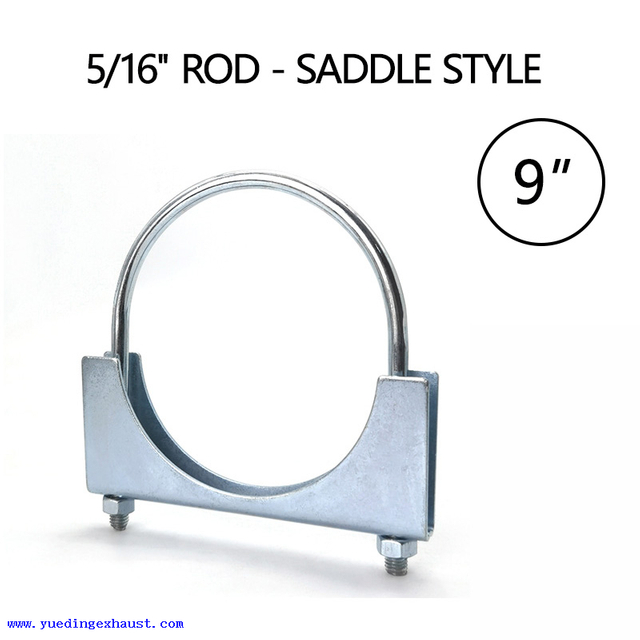
U-bolt exhaust clamps are very common in exhaust repair and replacement. They usually include a U-shaped bolt, a saddle, and nuts. When tightened, the U-bolt creates clamping force to secure the connection. They are often used on mufflers, tailpipes, and standard exhaust pipe joints.
The main advantages are simple structure, controlled cost, and easy coverage of common sizes. If your products need to cover regular repair sizes, U-bolt clamps are one of the easier types to standardize and keep in stock.
U-bolt clamps also have their limits. Their clamping force is more concentrated, and if they are over-tightened, they may leave marks or dents on the pipe surface. This does not mean U-bolt clamps are bad. It means they are more suitable for basic repair connections where cost control is important and frequent removal is not required. If your product needs easier removal, a cleaner appearance, or less pipe deformation, a band clamp may be a better choice.
Key details for U-bolt clamps include pipe outside diameter, U-bolt diameter, saddle shape, material, surface finish, and nut structure. For regular sizes sold over the long term, consistent packaging and labeling can also make repeat orders and warehouse identification easier.

Exhaust Band Clamps
Exhaust band clamps wrap around the pipe joint with a wider band. Compared with U-bolt clamps, they usually provide more even clamping force. They are often used for exhaust pipes, muffler connections, exhaust flex pipe assemblies, and repair sections where welding is not preferred.
One important advantage of band clamps is that they help reduce local pipe deformation and provide a cleaner connection appearance. This makes the product easier to understand: it is not just a basic fastener, but a better option for non-welded repair, replacement, and removable exhaust connections.
Band clamps also offer good product flexibility. They can include flat band clamps, stepped band clamps, narrow band clamps, wide band clamps, lap joint clamps, and butt joint clamps. The same product direction can be expanded into multiple sizes and structures based on different pipe joints.
If your products include exhaust flex pipes, muffler connection parts, or exhaust pipe kits, band clamps often provide more value than a simple fastener. They help connect the pipe and make the whole product look more complete.

Lap Joint Clamps
Lap joint clamps are used when one pipe slides into another pipe. This structure is common on muffler outlets, exhaust flex pipe extensions, replacement pipe sections, and slip-fit exhaust tubing.
Their value is that they fit the stepped area created by two different pipe diameters. If a flat band clamp is used on an overlapped joint, the contact may not be even and the clamping force may not be stable. A lap joint clamp is designed to cover this type of connection more effectively.
If your products need to be supplied together with exhaust flex pipes, mufflers, or connection pipes, lap joint clamps are useful. They reduce the need for customers to find extra connection parts and make your product closer to a complete connection solution instead of just a single pipe component.
The most common mistake with this type is unclear size description. One pipe size is usually not enough. You need to know the larger pipe outside diameter, the smaller pipe outside diameter, and the overlap length. Once these details are fixed, repeat orders and restocking become much more stable.

Butt Joint Clamps
Butt joint clamps are used when two pipes with the same outside diameter meet end to end. They are usually sleeve-style clamps that cover both pipe ends and create a non-welded connection.
Their advantage is a cleaner connection appearance and easier future removal compared with welding. For exhaust repair sections, straight pipe replacement parts, or standardized tubing combinations, butt joint clamps can make the product easier to assemble and sell.
Butt joint clamps are also easy to explain. If two pipes have the same outside diameter and meet end to end, a butt joint clamp is usually suitable. The customer does not need to understand a complicated structure to judge the basic fit.
However, butt joint clamps cannot replace lap joint clamps. If one pipe slides into another pipe, a lap joint clamp should be used. If two pipe ends meet directly with the same outside diameter, a butt joint clamp is more suitable.

V-Band Clamps
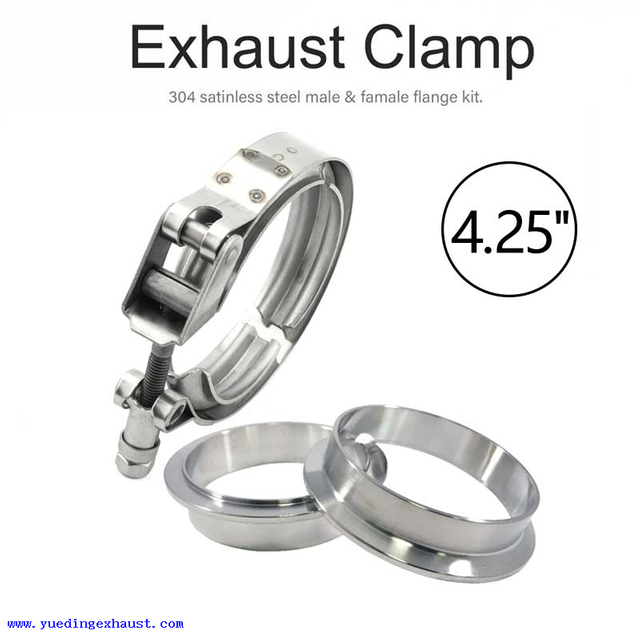
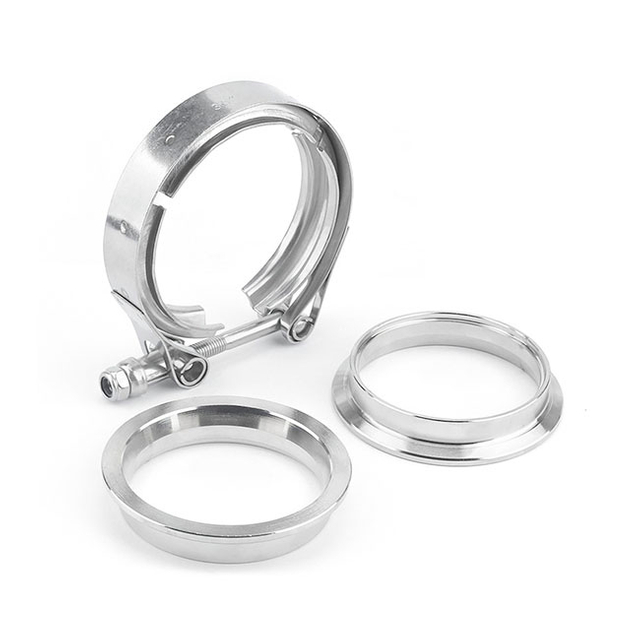
V-band clamps must be used with matching V-band flanges. They are commonly used in turbo systems, downpipes, performance exhaust systems, diesel exhaust systems, and other connections that need easy removal and maintenance.
Their main advantages are compact connection, easy removal, and strong product recognition. For performance exhaust parts, turbo connection parts, or flanged pipe assemblies, V-band clamps can improve the professional feel and set value of the product.
The key point of a V-band clamp is not only pipe size, but flange matching. The flange outside diameter, profile angle, groove shape, and clamp inner profile must match. Two V-band clamps may look similar, but if the flange profile is different, they may not be interchangeable.
If you supply V-band clamp kits, it is better to confirm the clamp and flange as one matched structure. This reduces the risk of mismatch and makes the product more suitable as a higher-value connection kit.

DPF Clamps and Heavy-Duty Exhaust Clamps
DPF clamps and heavy-duty exhaust clamps are commonly used in trucks, diesel engines, commercial vehicles, and large-diameter exhaust systems. These applications usually involve stronger vibration, higher temperatures, larger pipe sizes, and higher requirements for clamp structure and matching parts.
The value of these clamps is not only clamping force, but system matching. Many DPF or heavy-duty exhaust connections need to work with gaskets, flanges, spring bolts, or specific OE-style structures. If the clamp, gasket, and flange are not confirmed together, the final assembly may not fit well, may leak, or may take longer to install.
If your product range includes truck exhaust or diesel exhaust systems, DPF clamps and heavy-duty clamps can make the product line more professional. These parts may require more confirmation at the beginning, but once the specification and fitment are stable, they often have stronger repeat order value.

Special Exhaust Clamps and Custom Pipe Clamps
Some exhaust systems use O clamps, spherical clamps, spring joints, sleeve connector clamps, or other custom-formed clamps. These products are usually related to a specific pipe structure, installation space, vibration compensation, or original equipment design.
The value of special clamps is that they solve connection problems that standard clamps cannot cover. They may not be suitable for broad general stock, but they can be useful for special assemblies, repair kits, OE replacement parts, or project-based product development.
For these products, drawings, samples, and clear photos are more useful than the product name alone. The same name may refer to different structures, angles, thicknesses, or installation spaces.
Can Exhaust Clamps Replace Welding?
In some exhaust repair and replacement applications, exhaust clamps can be used as a non-welded connection method. U-bolt clamps, band clamps, butt joint clamps, and lap joint clamps can all help connect pipe sections and reduce the need for on-site welding.
However, clamps cannot replace welding in every situation. Whether they are suitable depends on pipe structure, pipe fitment, clamping area, vibration conditions, and sealing requirements. If the pipe end is badly deformed, the gap is too large, or the joint is under high stress, clamps alone may not provide the ideal result.
From a product-use point of view, clamps offer easier installation, more flexible maintenance, and better suitability for repair kits. But if your product emphasizes permanent fixing, structural strength, or special working conditions, welding, flanges, or a combined connection method may be more suitable.
Do Exhaust Clamps Leak?
An exhaust clamp is not an “absolute sealing part” by itself. Sealing performance depends on pipe fitment, clamp structure, material strength, clamping area, and installation method. A suitable clamp can help reduce exhaust leakage, but leakage may still happen if the pipe size is wrong, the pipe end is uneven, or the joint type is not matched correctly.
Band clamps usually provide more even clamping force than U-bolt clamps. Lap joint clamps and butt joint clamps must also match the correct pipe connection. V-band clamps need the correct flange profile, not just a similar outside diameter.
If you want to reduce leakage feedback after installation, the key is not simply to describe a clamp as “high sealing.” The more important point is to match the clamp structure with the pipe joint. For long-term supply, stable dimensions, tolerances, and matched parts are more important than a single sealing claim.
How Tight Should Exhaust Clamps Be?
Exhaust clamps need enough clamping force to secure the pipe, but tighter is not always better. Over-tightening may dent the pipe, deform the clamp, damage the bolt, or make later removal difficult.
U-bolt clamps are especially easy to over-tighten because of their structure, and this may press into the pipe surface. Band clamps have a larger clamping area, but they also need to be installed according to pipe size, material, and structure. V-band clamps depend more on flange fitment and even tightening.
If your customers often report installation problems, basic installation reminders can be added to product instructions, packaging labels, or product pages. This can reduce after-sales communication and make the product look more professional.
Material and Surface Finish Affect Product Positioning
The material of an exhaust clamp affects corrosion resistance, heat resistance, strength, cost, and service life. For the same clamp structure, different materials may fit different product levels and market needs.
Material / Finish | Suitable Application | Product Value |
|---|---|---|
304 Stainless Steel | Exhaust systems with higher corrosion resistance needs | Suitable for mid- to high-level replacement parts and longer service life |
409 Stainless Steel | Automotive exhaust systems | Common exhaust material with a balance of heat resistance and cost |
316 Stainless Steel | High-corrosion or special environments | Used when stronger corrosion resistance is required |
Aluminized Steel | Standard repair and aftermarket replacement | Cost-friendly option for regular replacement parts |
Zinc-Plated Steel | U-bolt clamps and general fastening parts | Economical option for basic repair products |
Material choice is not only a technical issue. It also affects how the product is positioned. Stainless steel clamps are easier to explain through corrosion resistance and service life. Zinc-plated or aluminized steel clamps are more suitable for cost-sensitive repair applications. For long-term supply, keeping the material grade and surface finish consistent helps maintain batch consistency.
Accurate Clamp Size Leads to Better Installation Feedback
Exhaust clamp size is often underestimated. A product may look like a simple 2 inch, 2.5 inch, or 3 inch clamp, but the actual fit also depends on pipe outside diameter, wall thickness, expanded ends, slots, flange structure, and installation space.
Accurate sizing brings direct value: smoother installation, fewer returns, and more stable customer feedback. For regular sizes supplied over the long term, it is better to keep a clear record of pipe diameter, band width, material, bolt structure, and packaging information. This makes future restocking more efficient.
If your products include exhaust flex pipes or exhaust pipe assemblies, the clamp size should be confirmed together with the pipe component. For example, check whether the flex pipe has extension pipes, what the outside diameter of the extension pipe is, and whether a lap joint clamp is needed. For V-band flanges, check whether the flange profile matches the clamp. If the exhaust pipe is slotted, this may also affect clamping performance.
In Yueding’s exhaust system product range, exhaust clamps can usually be confirmed together with exhaust flex pipes, V-band flanges, exhaust pipes, elbows, and sleeve connectors. If you are working on a complete connection product, the clamp should not be added at the last step. It should be considered as part of the whole connection structure.
How Do Exhaust Clamps Improve Product Combination Value?
When viewed alone, a clamp is a small accessory. But when placed in an exhaust system product combination, it can improve the completeness of the whole product. For example, an exhaust flex pipe with matched clamps can reduce the need for customers to find extra connection parts. Exhaust pipes and elbows with matching clamps can be closer to a ready-to-install solution. V-band clamps supplied with flanges are more suitable as a clear connection kit.
This brings real value to your business. Customers are not only buying one part. They are also reducing matching work, getting more stable installation feedback, and making repeat orders easier. In repair and replacement markets, the easier a product is to explain and install, the easier it is to sell repeatedly.
An exhaust clamp article should not only list the types of clamps. It should explain why each structure fits a certain product, what connection problem it solves, and how it helps make the product line more complete.
What Support Can Yueding Provide for Exhaust Clamps?
Yueding supplies different exhaust clamps and pipe connection parts, including U-bolt clamps, band clamps, lap joint clamps, butt joint clamps, V-band clamps, DPF clamps, sleeve clamps, and related fastening parts.
In addition to standard sizes, we can confirm details based on drawings, samples, pipe diameter, material, surface finish, band width, bolt structure, packaging, and labeling requirements. For products that need to be matched with exhaust flex pipes, mufflers, exhaust pipes, elbows, or flanges, clamps can also be confirmed together during the structure confirmation stage.
If you already have a sample, you can provide the sample or clear photos. If it is a new project, you can first provide the pipe size, joint type, and target application. This makes it easier to confirm the right clamp structure and reduce uncertainty in sample adjustment and batch production.

Professional Exhaust Clamp Manufacturer & Supplier
Yueding’s factory covers over 20,000 square meters and is equipped with automated and semi-automated production facilities for German type hose clamps and related metal components. With more than 200 full-time staff, including experienced engineers and production teams, we support stable batch production, mixed-size orders, and long-term supply needs.
Our products are exported to more than 110 countries, with annual sales exceeding USD 10 million. Certified under ISO 9001, ISO 45001, IATF 16949, and RoHS, Yueding provides reliable manufacturing and quality support for automotive, industrial hose, machinery, and piping applications.
FAQ
I only know the exhaust pipe diameter. How do I know which exhaust clamp to choose?
Pipe diameter alone is not enough. You need to check the pipe joint type first, then confirm the size. If two pipes have the same outside diameter and meet end to end, a butt joint clamp or sleeve clamp may be suitable. If one pipe slides into another pipe, a lap joint clamp is usually needed. If the connection uses flanges, a V-band clamp may be required.
If you are not sure which type you need, you can start with the pipe outside diameter, photos of the joint, whether the pipe end is expanded or slotted, and the installation position. This is much clearer than only saying “2 inch clamp.” For bulk or custom orders, confirming the joint structure early can reduce sample changes later.
What is the difference between a lap joint clamp and a butt joint clamp?
The easiest way to tell the difference is to check whether the two pipes overlap.
If one pipe slides into another pipe, the joint has two different diameters. This is usually a lap joint, and a lap joint clamp is more suitable for this stepped connection.
If two pipes have the same outside diameter and meet end to end, a butt joint clamp is usually used. It works more like a sleeve that covers both pipe ends.
These two clamp types should not be selected only by size. Even if both are called 2.5 inch clamps, the structure may be different because the pipe joint is different. Before purchasing or customizing, it is better to confirm the larger pipe OD, smaller pipe OD, or provide photos of the connection.
Why can’t a V-band clamp be selected only by exhaust pipe size?
A V-band clamp does not directly clamp a plain exhaust pipe. It clamps two V-band flanges. The key matching points are flange outside diameter, flange profile angle, groove shape, and the inner profile of the clamp.
So “3 inch V-band clamp” is usually not enough information. The 3 inch size may refer to pipe diameter, but different flanges may have different outside diameters and profiles. If the flange and clamp do not match, the connection may not assemble, lock properly, or seal well.
If you need a V-band clamp, it is better to provide the flange sample, drawing, profile photo, or existing clamp photo. For kit supply, confirming the clamp and flange together is more reliable.
Which is better for an exhaust system: U-bolt clamp, band clamp, or V-band clamp?
These three clamp types are used for different connection conditions, so it is not useful to say one is always better.
A U-bolt clamp has a simple structure and is suitable for many standard repair and replacement applications. It is cost-effective, but it may leave marks on the pipe surface.
A band clamp has a wider clamping area, a cleaner appearance, and is more suitable when you want less pipe deformation.
A V-band clamp is used with flanges. It is common in removable, compact, or higher-requirement exhaust connections.
For standard repair parts, U-bolt clamps or band clamps are usually considered first. For flanged connections, turbo pipes, or exhaust assemblies, you should check whether a V-band clamp is more suitable.
For custom exhaust clamps, which details are more important than the product name?
The product name only gives a general direction. The real production and installation details depend on structural information. Important details include pipe outside diameter, joint type, band width, material, thickness, bolt structure, surface finish, gasket requirement, and whether the clamp needs to match an exhaust flex pipe, flange, or pipe component.
For example, a “band clamp” may be a butt joint clamp, lap joint clamp, wide band clamp, or narrow band clamp. A “V-band clamp” may not be interchangeable if the flange profile is different.
If you do not have a complete drawing, you can provide sample photos, pipe size, installation position, and estimated quantity first. The factory can then check whether an existing size can be used or whether a custom sample is needed.
How can I reduce the risk of buying the wrong exhaust clamps in bulk?
Do not order only by keyword or rough size. Exhaust clamps need to match the pipe joint structure, especially for butt joint clamps, lap joint clamps, V-band clamps, and DPF clamps. Some products may look similar, but their installation conditions can be very different.
Before bulk purchasing, it is better to confirm a sample or drawing and fix the key parameters, such as pipe diameter, clamp width, material, bolt structure, packaging method, and label requirements. This helps avoid confusion in repeat orders.
If you are buying matched parts, such as exhaust flex pipes with clamps, V-band clamps with flanges, or DPF clamps with gaskets, it is better to confirm the whole connection structure instead of checking only one clamp. This can reduce assembly mismatch and support more stable long-term supply.





About Yueding
YUEDING manufactures stainless steel exhaust flexible connectors, clamps, metal bellows, and selected automotive exhaust components under ISO and IATF quality systems. With in-house production, inspection, and packaging capabilities, we support bulk orders, standard-size inventory, and customized branding for global B2B customers.
Reliable Delivery
Stable production planning, standard-size inventory, and batch shipping support help make delivery more predictable.

Factory Direct
Production, inspection, and packaging are managed in-house, making communication, quality control, and customization more efficient.

Integrated Supply
We supply flex pipes, clamps, metal bellows, and selected exhaust components to support related purchasing needs from one manufacturer.

