
Do Exhaust Clamps Work?
Can a bolt-on component securely connect an exhaust system without welding? For most standard exhaust repairs and modular systems, the answer is yes—provided that the clamp matches the pipe size, joint type, material, and operating conditions.
Exhaust clamps are commonly used on passenger vehicles, commercial vehicles, performance systems, and industrial equipment. Their reliability depends less on whether they are welded and more on correct selection, sound pipe condition, proper alignment, and controlled installation.
Key Takeaways
● Exhaust clamps can create a dependable connection when correctly matched to the exhaust joint.
● U-bolt, band, sleeve, and V-band clamps serve different applications and should not be treated as interchangeable.
● Selection should consider pipe dimensions, joint structure, temperature, corrosion exposure, installation space, and future maintenance.
● Clamps cannot reliably repair severely rusted, cracked, or deformed tubing.
● Tightening requirements vary by clamp design, bolt size, and pipe thickness, so universal torque values should be avoided.
● Clamps are often suitable for removable systems, while welding may be preferable for permanent structural repairs.

The Verdict: How Well Do Exhaust Clamps Actually Work?
Exhaust clamps work by applying pressure around the connection between two exhaust components. When the pipe surfaces fit properly, this pressure helps maintain alignment, reduce movement, and limit gas leakage.
However, not every clamp creates the same type of connection. Some designs mainly hold overlapping pipes together, while others distribute pressure more evenly or pull matching flanges into contact.
Performance depends on several factors:
● Correct pipe and clamp dimensions
● Suitable joint structure
● Sufficient sound metal around the connection
● Proper exhaust support and alignment
● Appropriate material for the environment
● Correct tightening procedure
A clamp may work well on a properly fitted muffler connection but fail on badly corroded pipe or two incompatible tube sizes. For this reason, exhaust clamps should be selected according to the actual connection rather than treated as a universal repair solution.
Why Exhaust Clamps Can Create an Effective Connection
Most exhaust clamps apply compressive force around a pipe joint. In an overlapping connection, the outer pipe is pressed against the inner pipe. In a butt joint, a band or sleeve bridges two pipe ends. A V-band clamp works differently by pulling two matching flanges together.
This wider pressure distribution can help reduce localized gaps and maintain pipe alignment. Clamped joints also allow components to be adjusted or removed without cutting the exhaust system apart.
Another benefit is that clamps can connect exhaust components made from different materials without introducing welding heat. However, the materials must still be suitable for the operating temperature and corrosion conditions.
Feature | Clamping benefit | Selection consideration |
Pressure distribution | Holds pipe surfaces together | Depends on clamp and joint design |
Removability | Allows later servicing | Corrosion may still make removal difficult |
No welding heat | Avoids a heat-affected area | Material compatibility still matters |
Adjustability | Helps with exhaust alignment | Clamp should not correct major misalignment |
How to Choose the Right Exhaust Clamp
The first selection step is identifying how the two exhaust parts connect.
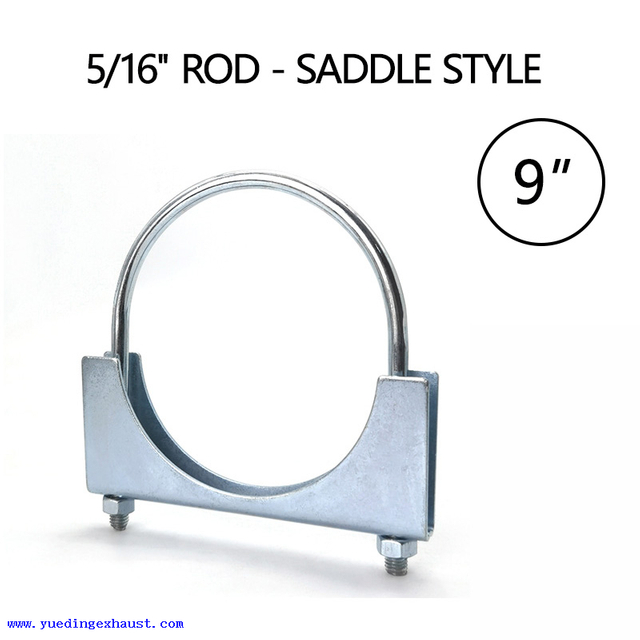
U-Bolt Clamps
U-bolt clamps are commonly used on overlapping slip-fit pipes. They are economical and can create a strong mechanical grip.
They are generally suitable for:
● Basic muffler replacement
● Overlapping exhaust pipes
● Installations where future removal is not a priority
● Applications with enough space for the threaded legs
Because their pressure is concentrated, they can deform the outer pipe. This may make the connection harder to separate later.
Lap-Joint Band Clamps
Lap-joint band clamps are designed for connections where one pipe slides over another. Their formed or stepped structure matches the larger and smaller pipe sections.
They are often selected when buyers want:
● Wider pressure distribution
● Less pipe deformation
● Cleaner appearance
● Easier future servicing
The clamp orientation must match the overlapping joint. Installing it in the wrong direction can produce uneven pressure.
Butt-Joint Band Clamps
Butt-joint clamps connect two pipes with similar outside diameters. The band bridges the meeting point rather than compressing one pipe over another.
They are suitable when:
● Two equal-size pipes meet end to end
● Pipe length should not be reduced through overlapping
● Welding is not preferred
● A removable connection is required
Both pipe ends should be straight, round, and closely aligned. Large gaps or angled cuts may prevent proper sealing.
V-Band Clamps
V-band clamps are used with matching flanges rather than directly around plain tubing. They are common in performance, turbocharged, motorsport, and frequently serviced systems.
They offer compact installation and convenient disassembly, but the clamp must match the flange profile. Poor flange alignment, incompatible dimensions, or distorted sealing surfaces can still cause leaks.
OEM-Style Couplers
Some vehicles and equipment use formed couplers designed around expanded, slotted, or specially shaped pipe ends. These should be selected using the original part specification, a drawing, or an approved sample rather than pipe diameter alone.
Important Selection Factors Beyond Clamp Type
Pipe Dimensions
Do not rely only on a stated pipe size. Exhaust tubing may be described by outside diameter, inside diameter, or nominal diameter.
Before ordering, confirm:
● Outside diameter of both pipe sections
● Inside diameter of the receiving pipe
● Available straight clamping area
● Whether the pipe is expanded, slotted, flared, or beaded
● Available clearance around the joint
A caliper usually provides a more reliable measurement than a ruler.
Joint Serviceability
If the muffler, catalytic converter, filter, test section, or performance component may need to be removed later, a band clamp or flanged connection may be more practical than a pipe-deforming U-bolt design.
However, a removable clamp does not guarantee effortless disassembly after long-term heat and corrosion exposure.
Material and Corrosion Exposure
Common clamp materials include coated carbon steel, aluminized steel, and stainless steel. The appropriate option depends on road salt, humidity, temperature, expected service life, and budget.
Buyers should also check the bolts and nuts. A corrosion-resistant band with unsuitable fasteners may still become difficult to service.
For bulk orders, request the actual material grade, surface treatment, band thickness, and fastener specification instead of relying only on descriptions such as “heavy duty” or “stainless.”
Mechanical Load and Alignment
A clamp should secure a correctly supported exhaust system. It should not replace missing hangers or pull badly misaligned pipes into position.
Consider component weight, engine movement, vibration, nearby supports, and the distance between the clamp and exhaust hangers. Continuous bending or twisting force can loosen even a correctly installed clamp.
Installation Space
Check whether the clamp will interfere with heat shields, suspension parts, wiring, sensors, the vehicle floor, or other nearby components.
U-bolt clamps need space for threaded legs and nuts, while wide band clamps require a suitable straight pipe section.
Exhaust Clamps vs. Welding
Clamping and welding serve different purposes.
Clamps may be more practical when:
● Components need adjustment during installation
● The exhaust may require future disassembly
● Welding equipment is unavailable
● Nearby parts should not be exposed to welding heat
● A bolt-on replacement is preferred
Welding may be more suitable when:
● A permanent joint is required
● There is insufficient space for a clamp
● The pipe lacks a usable clamping surface
● Custom fabrication or structural reinforcement is needed
● The exhaust design specifically requires a welded connection
Neither method can compensate for severely deteriorated tubing. Welding quality also depends on material condition, preparation, and operator skill.
Common Reasons Exhaust Clamps Fail
Incorrect Clamp or Joint Type
A lap-joint clamp will not perform correctly on two equal-diameter pipes, while a butt-joint clamp may not fit an overlapping connection.
Wrong Diameter
An oversized clamp may tighten fully without applying enough pressure. An undersized clamp may sit incorrectly or deform the pipe.
Corroded or Damaged Tubing
Deep rust, holes, cracks, collapsed pipe, and thin metal reduce the contact area and strength required for a clamped joint.
Poor Exhaust Alignment
The exhaust should sit naturally before the clamp is tightened. Using the clamp to force components together creates continuous stress at the connection.
Incorrect Tightening
Insufficient tightening may allow leakage or movement. Excessive tightening may deform thin-wall pipe, damage threads, or distort the clamp.
Follow the clamp, vehicle, or exhaust manufacturer’s instructions rather than applying one torque value to every product.
Unsuitable Material
A clamp exposed to moisture, road salt, mud, and heat may corrode prematurely if its material or coating is unsuitable for the environment.
How to Install an Exhaust Clamp Correctly
Begin by removing loose rust, old sealant, carbon deposits, and burrs from the mating surfaces. Check that the pipe ends are structurally sound and reasonably round.
Test-fit the complete exhaust section before final tightening. Confirm that the pipes engage correctly, the hangers are not stretched, and the system does not contact the vehicle body.
Position the clamp over the actual joint rather than near an unsupported pipe edge. Directional lap-joint clamps should face the correct larger and smaller pipe sections.
Tighten the fasteners gradually and evenly. If the joint still leaks, inspect the clamp size, pipe fit, surface condition, and alignment instead of continuing to apply more force.
After initial operation, check for soot marks, unusual exhaust noise, loose hardware, pipe movement, or changes in alignment. Follow the product instructions regarding any later inspection or re-tightening.
Where Exhaust Clamps Work—and Where They Do Not
Exhaust clamps are commonly suitable for:
● Muffler and resonator replacement
● Passenger and commercial vehicle exhaust systems
● Performance exhaust assemblies
● Generator and machinery exhausts
● Modular test systems
● Serviceable filter and converter sections
They are not a reliable solution when the pipe is severely rusted, perforated, heavily deformed, unsupported, or badly misaligned. In those situations, the damaged section should normally be repaired or replaced before a clamp is installed.
Conclusion
Exhaust clamps can provide a practical and dependable connection when the correct design is matched to the joint.
Selection should begin with the connection type, followed by pipe dimensions, material, corrosion exposure, maintenance requirements, mechanical load, and available space. Buyers should avoid choosing a clamp based only on its advertised diameter.
For replacement or bulk purchasing, customers can provide yuedingexhaust with pipe measurements, joint photographs, material requirements, application details, and order quantities. Clear specifications help reduce incorrect fitment and installation problems.
FAQs
Can an exhaust clamp repair a hole in a rusted pipe?
A clamp may secure a repair sleeve over sound metal, but it cannot restore pipe that is thin, perforated, or structurally weak. Severely damaged sections should normally be replaced.
Do exhaust clamps require sealing paste?
Not every connection requires paste. It may help fill minor surface imperfections in some slip-fit joints, but it should not be used to compensate for the wrong clamp size, damaged tubing, or excessive gaps.
Can an old exhaust clamp be reused?
Reuse depends on the clamp design and condition. Replace clamps with distorted bands, stretched threads, damaged fasteners, heavy corrosion, or permanent deformation.
What should a buyer provide when ordering custom exhaust clamps?
Provide pipe dimensions, joint type, material requirements, application conditions, drawings or samples, expected quantity, packaging needs, and any testing or documentation requirements.
How should distributors evaluate exhaust clamp suppliers?
Compare dimensional consistency, verified materials, band and fastener specifications, sample fit, production tolerances, inspection procedures, documentation, packaging, and batch traceability—not only unit price.






About Yueding
YUEDING manufactures stainless steel exhaust flexible connectors, clamps, metal bellows, and selected automotive exhaust components under ISO and IATF quality systems. With in-house production, inspection, and packaging capabilities, we support bulk orders, standard-size inventory, and customized branding for global B2B customers.
Reliable Delivery
Stable production planning, standard-size inventory, and batch shipping support help make delivery more predictable.

Factory Direct
Production, inspection, and packaging are managed in-house, making communication, quality control, and customization more efficient.

Integrated Supply
We supply flex pipes, clamps, metal bellows, and selected exhaust components to support related purchasing needs from one manufacturer.

